-
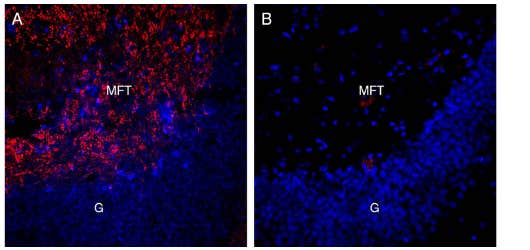 A Guinea Pig Polyclonal Antibody to α-Synuclein
- Product Code: APZ-035-GP
- Short Description: A Guinea Pig Polyclonal Antibody to α-Synuclein
- Host: Guinea Pig
- Label: Unconjugated
- Reactivity: Rat, Mouse
- Applications: Western blot, Immunohistochemistry
- Target: α-Synuclein, Non-A4 component of amyloid precursor, Parkinson disease (autosomal dominant, Lewy body) 4, PARK1, PARK4, NACP, SNCA
-
 A Guinea Pig Polyclonal Antibody to Angiotensin-(1-7) Mas Receptor
- Product Code: AAR-013-GP
- Short Description: A Guinea Pig Polyclonal Antibody to Angiotensin-(1-7) Mas Receptor
- Host: Guinea Pig
- Label: Unconjugated
- Reactivity: Human, Rat, Mouse
- Applications: Western blot
- Target: Proto-oncogene Mas, MAS1
-
 A Guinea Pig Polyclonal Antibody to Aquaporin 4 (AQP4)
- Product Code: AQP-014-GP
- Short Description: A Guinea Pig Polyclonal Antibody to Aquaporin 4 (AQP4)
- Host: Guinea Pig
- Label: Unconjugated
- Reactivity: Rat, Mouse
- Applications: Western blot, Immunohistochemistry
- Target: WCH4, Mercurial-insensitive water channel, MIWC
-
 A Guinea Pig Polyclonal Antibody to ASIC1 Channel
- Product Code: ASC-014-GP
- Short Description: A Guinea Pig Polyclonal Antibody to ASIC1 Channel
- Host: Guinea Pig
- Label: Unconjugated
- Reactivity: Human, Rat, Mouse
- Applications: Western blot, Immunocytochemistry, Immunofluorescence, Immunohistochemistry
- Target: Acid-sensing ion channel 1, Amiloride-sensitive brain sodium channel, BNaC2, ACCN2
-
 A Guinea Pig Polyclonal Antibody to ASIC3 Channel
- Product Code: ASC-018-GP
- Short Description: A Guinea Pig Polyclonal Antibody to ASIC3 Channel
- Host: Guinea Pig
- Label: Unconjugated
- Reactivity: Rat, Mouse
- Applications: Western blot, Immunofluorescence, Immunohistochemistry
- Target: Acid-sensing ion channel 3, Amiloride-sensitive cation channel 3, ACCN3, DRASIC
-
 A Guinea Pig Polyclonal Antibody to BDNF
- Product Code: ANT-010-GP
- Short Description: A Guinea Pig Polyclonal Antibody to BDNF
- Host: Guinea Pig
- Label: Unconjugated
- Reactivity: Human, Rat, Mouse
- Applications: Western blot, Immunofluorescence, Immunohistochemistry
- Target: Brain-derived neurotrophic factor
-
 A Guinea Pig Polyclonal Antibody to Cannabinoid Receptor 1 (extracellular)
- Product Code: ACR-001-GP
- Short Description: A Guinea Pig Polyclonal Antibody to Cannabinoid Receptor 1 (extracellular)
- Host: Guinea Pig
- Label: Unconjugated
- Reactivity: Human, Rat, Mouse
- Applications: Western blot, Immunohistochemistry
- Target: CB1, CB-R, CB1R, CANN6, Brain-type cannabinoid receptor, Central cannabinoid receptor, CNR1
-
 A Guinea Pig Polyclonal Antibody to CaV1.2 (CACNA1C) Channel
- Product Code: ACC-003-GP
- Short Description: A Guinea Pig Polyclonal Antibody to CaV1.2 (CACNA1C) Channel
- Host: Guinea Pig
- Label: Unconjugated
- Reactivity: Human, Rat, Mouse
- Applications: Western blot, Immunofluorescence, Immunohistochemistry
- Target: Voltage-dependent L-type calcium channel subunit α1C
-
 A Guinea Pig Polyclonal Antibody to CaV1.3 (CACNA1D) Channel
- Product Code: ACC-005-GP
- Short Description: A Guinea Pig Polyclonal Antibody to CaV1.3 (CACNA1D) Channel
- Host: Guinea Pig
- Label: Unconjugated
- Reactivity: Human, Rat, Mouse
- Applications: Western blot, Immunofluorescence, Immunohistochemistry
- Target: Voltage-dependent L-type calcium channel subunit α1D
-
 A Guinea Pig Polyclonal Antibody to Acetylcholine receptor muscarinic 3
- Product Code: AMR-006-GP
- Short Description: A Guinea Pig Polyclonal Antibody to Acetylcholine receptor muscarinic 3
- Host: Guinea Pig
- Label: Unconjugated
- Reactivity: Human, Rat, Mouse
- Applications: Western blot, Immunohistochemistry
- Target: Cholinergic receptor muscarinic 3, Acetylcholine receptor muscarinic 3, M3 AChR
Loading...