

Fluorophore Custom Conjugation
Sometimes the exact tool you need isn’t in the catalog. We offer professional custom peptide and protein conjugation services to a wide range of fluorophores. Our conjugates enable direct detection in live-cell imaging, fluorescence microscopy (including IF applications), and flow cytometry. Using directly labeled reagents simplifies your workflow, eliminates reliance on secondary detection systems, and enables robust multiplexing.
Advantages of Custom Conjugation Service
Customization
Tailored to your exact fluorophore and target specifications.
Streamlined Protocols
Direct detection enables one-step labeling, significantly shortening experimental timelines.
Simplified Multiplexing
Facilitates complex multicolor staining by direct and simultaneous target detection.
Live-Cell Compatibility
Enables real-time observation of cellular dynamics and protein-receptor interactions.
Enhanced Signal Integrity
Direct conjugation reduces non-specific background noise often associated with signal amplifying systems.
Scalability & Stability
Bulk sizes and progressive pricing are available for large-scale orders. Shipped as a stable, lyophilized powder to ensure long-term performance.

“Egestas aenean et vitae mattis ut in mattis lacus sed. Nunc eget tellus sollicitudin massa suscipit. Felis posuere in sed varius amet egestas maecenas nunc tellus.”
Uses & Applications
Our custom conjugation services support a wide range of research applications, providing direct, sensitive, and reproducible results. These fluorescently labeled conjugates are optimized for direct detection and multiplex assay design, allowing for the precise visualization of biological interactions without the need for secondary reagents.

Fluorescence Imaging & Super-resolution Microscopy
Direct visualization of targeted proteins .

Western Blot & Blot-Based Assays
Fluorophore-conjugated proteins enable direct, consistent detection in fluorescent western blot.

ELISA
Fluorophore-conjugated peptides support sensitive and reproducible ELISA-based detection.

Multiplex Immunodetection
Simultaneous multi-target detection using spectrally distinct fluorophore conjugations for complex assay designs.

Flow Cytometry & Imaging Flow Cytometry
Custom-labeled conjugates support flow cytometry panel design and robust multiplex analysis of surface markers, ensuring precise target detection.

In Vivo
Custom conjugation allows tailored labeling for selected in vivo studies, improving consistency and signal quality.

Tissue Clearing
Optimized labeling strategies for tissue clearing, improving signal penetration and image clarity.
Tissue Clearing
Optimized labeling strategies for tissue clearing, improving signal penetration and image clarity.

Pull-Down & Capture Assays
Biotinylated toxins and growth factors support streptavidin-based pull-down and protein interaction studies.
Fluorophore Conjugation Service Specifications
Validated Materials
Conjugation is performed using our toxins or proteins, which undergo HPLC, MS, and bioactivity validation before labeling.
Targeted Conjugation
We use amine-reactive reagents to covalently attach your chosen fluorophore to primary amine groups (e.g., N-terminus or Lysine residues).
Purification
We remove all free dye and determine the exact Degree of Labeling (DOL).
Final Validation
The final conjugate is validated via HPLC, MS, and biological activity. (Biological activity assay eliminates non-active conjugates.)
Extended Testing
Extended bioassay testing via FACS, live-cell imaging, or fluorescence microscopy (including frozen sections) is possible upon request.
Service Notes
Minimum order: 5 × 10 µg.
Fluorophore Conjugation Service Specifications
This fluorescent labeling service includes:
Validated Materials: Conjugation is performed using our toxins or proteins, which undergo HPLC, MS, and bioactivity validation before labeling.
Targeted Conjugation: We use amine-reactive reagents to covalently attach your chosen fluorophore to primary amine groups (e.g., N-terminus or Lysine residues).
Purification: We remove all free dye and determine the exact Degree of Labeling (DOL).
Final Validation: The final conjugate is validated via HPLC, MS, and biological activity (Biological activity assay eliminates non-active conjugates.)
Extended Testing: Extended bioassay testing via FACS, live-cell imaging, or fluorescence microscopy (including frozen sections) is possible upon request.
Service Notes:
Minimum order: 5 × 10 µg.
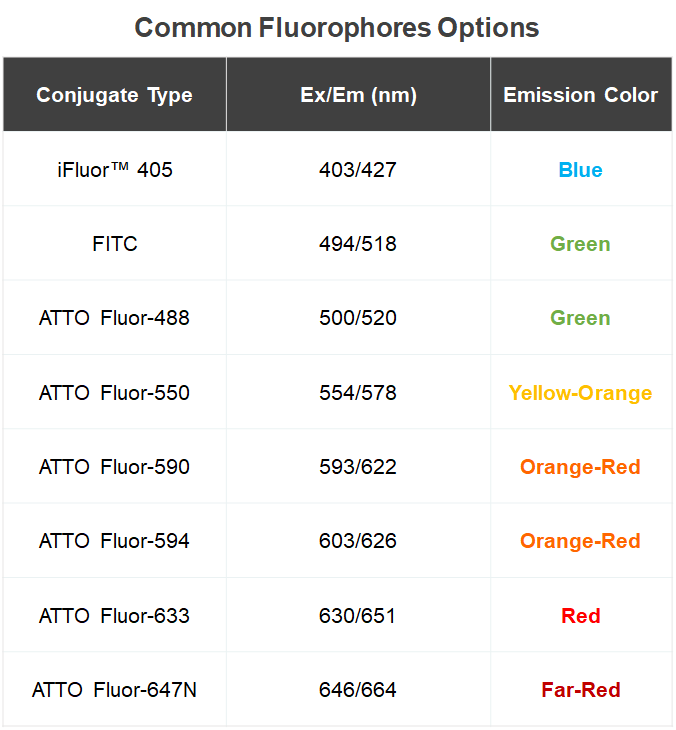
Common Fluorophores Options
| Conjugate Type | Excitation (nm) | Emission (nm) | Emission Color | Recommended Lasers (nm) |
| mFluor Violet™ 450 | 407 | 455 |
Violet
|
405 |
| FITC | 494 | 518 |
Green
|
488 |
| ATTO Fluor-488 | 500 | 520 |
Green
|
488 |
| ATTO Fluor-550 | 554 | 578 |
Yellow-Orange
|
561 |
| ATTO Fluor-590 | 593 | 622 |
Orange-Red
|
561 |
| ATTO Fluor-594 | 603 | 626 |
Orange-Red
|
561 |
| ATTO Fluor-633 | 630 | 651 |
Red
|
640 |
| ATTO Fluor-647N | 646 | 664 |
Far-Red
|
640 |
Data Highlights
Magna sit velit sit mollis elit vitae ornare vitae. Facilisi ultrices id scelerisque lacus congue semper. Quis sollicitudin morbi aliquet in proin. Nec aliquam elementum sed convallis ultricies phasellus mi.

Aliquet eget vulputate dignissim placerat. Odio sit auctor viverra fames commodo. Consectetur neque ullamcorper sed egestas. Tortor elementum tortor vulputate elit facilisis imperdiet. Auctor id et ante posuere scelerisque mauris vestibulum.
Get Your Custom Quote
Validated conjugation to fluorophores, enzymes, or biotin for antibodies and toxins, with flexible quantities,
bulk pricing, and lot reservation tailored to your needs.
FAQs
View all FAQs >
If you can’t find the answer, please contact us.
-
The DOL indicates the average number of dye or biotin molecules attached to each conjugated molecule. The specific number of dye or biotin molecules attached to each product is provided on the relevant product webpage in the Specifications section, under the “Label” entry.
-
Yes, each conjugated venom toxin is carefully evaluated to confirm that its biological activity is preserved after conjugation. We perform electrophysiological testing using either Xenopus oocytes or mammalian cells expressing the relevant protein targets. The activity of the conjugated toxin is then directly compared with that of the corresponding unconjugated (native) toxin. This comparative analysis allows us to verify that the conjugation process does not compromise the toxin’s functional activity or its ability to interact with the target protein. Detailed assay descriptions are available on the relevant product webpage.
-
Conjugated venom toxins are most suitable for live imaging applications. Conjugated venom toxins are superior probes for live-cell imaging of their protein targets, due to their small size, high affinity, and ability to bind native extracellular targets. Unlike antibodies, they have evolved to target the native, functional states of these targets with minimal non-specific binding. In contrast, while conjugated antibodies are more versatile, they are often less optimal for studying target protein dynamics in some living cells due to the internalization of the antibody-antigen complex.
-
Yes. Detailed protocols are available online to support the optimal use of conjugated toxins across various applications. Please refer to our protocols here: Live imaging, Flow cytometry, Immunofluorescence, and Multiplex Immunodetection.
-
The biological activity of the conjugated neurotrophin is always directly compared to that of the corresponding unconjugated (native) neurotrophin. This side-by-side comparison allows us to confirm that the conjugation process does not significantly affect receptor binding, signaling capability, or functional activity. Only bioactive conjugated neurotrophins are commercialized.
-
Yes. Detailed protocols are available online to support the optimal use of conjugated neurotrophins across various applications. Please refer to our protocols here: Immunofluorescence, Flow cytometry, and Live imaging.
-
Standard laboratory safety precautions are generally sufficient when handling venom toxins. Appropriate personal protective equipment (PPE), such as a lab coat and nitrile gloves, should be worn at all times. However, users should always consult the specific Safety Data Sheet (SDS) for each venom toxin to review any particular hazards and recommended handling procedures.