-
 A Guinea Pig Polyclonal Antibody to TRPV2 (VRL1) Channel
- Product Code: ACC-039-GP
- Short Description: A Guinea Pig Polyclonal Antibody to TRPV2 (VRL1) Channel
- Host: Guinea Pig
- Label: Unconjugated
- Reactivity: Rat, Mouse
- Applications: Live cell imaging, Western blot, Immunocytochemistry, Immunofluorescence, Immunohistochemistry
- Target: Transient receptor potential cation channel subfamily V member 2, Vanilloid receptor-like protein 1, VRL-1, Osm-9-like TRP channel 2, OTRPC2, Stretch-activated channel 2B, SAC2B
-
 A Guinea Pig Polyclonal Antibody to TRPV4 Channel
- Product Code: ACC-034-GP
- Short Description: A Guinea Pig Polyclonal Antibody to TRPV4 Channel
- Host: Guinea Pig
- Label: Unconjugated
- Reactivity: Mouse
- Applications: Western blot
- Target: OTRPC4, VRL-2, VR-OAC, TRP12
-
 A Guinea Pig Polyclonal Antibody to Vasopressin V1A Receptor (AVPR1A)
- Product Code: AVR-010-GP
- Short Description: A Guinea Pig Polyclonal Antibody to Vasopressin V1A Receptor (AVPR1A)
- Host: Guinea Pig
- Label: Unconjugated
- Reactivity: Human, Rat, Mouse
- Applications: Western blot, Immunohistochemistry
- Target: V1aR, AVPR V1a, Antidiuretic hormone receptor 1a, Vascular/hepatic-type arginine vasopressin receptor
-
 A Guinea Pig Polyclonal Antibody to Vesicular GABA Transporter
- Product Code: AGT-005-GP
- Short Description: A Guinea Pig Polyclonal Antibody to Vesicular GABA Transporter
- Host: Guinea Pig
- Label: Unconjugated
- Reactivity: Human, Rat, Mouse
- Applications: Western blot, Immunohistochemistry
- Target: Vesicular inhibitory amino acid transporter, VIAAT, GABA and glycine transporter, rGVAT, SLC32A1
-
 A Guinea Pig Polyclonal Antibody to VGLUT1
- Product Code: AGC-035-GP
- Short Description: A Guinea Pig Polyclonal Antibody to VGLUT1
- Host: Guinea Pig
- Label: Unconjugated
- Reactivity: Human, Rat, Mouse
- Applications: Western blot, Immunohistochemistry
- Target: Vesicular glutamate transporter 1, Brain-specific Na+-dependent inorganic phosphate cotransporter, BNPI, SLC17A7
-
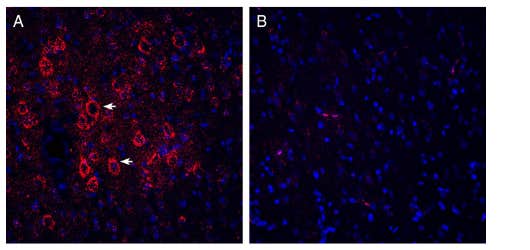 A Guinea Pig Polyclonal Antibody to Vesicular Glutamate Transporter 2
- Product Code: AGC-036-GP
- Short Description: A Guinea Pig Polyclonal Antibody to Vesicular Glutamate Transporter 2
- Host: Guinea Pig
- Label: Unconjugated
- Reactivity: Human, Rat, Mouse
- Applications: Western blot, Immunohistochemistry
- Target: Vesicular glutamate transporter 2, Differentiation-associated Na+-dependent inorganic phosphate cotransporter, DNPI, SLC17A6
-
 A Mouse Monoclonal Antibody to GIRK1 (Kir3.1) Channel
- Product Code: ALM-031
- Short Description: A Mouse Monoclonal Antibody to GIRK1 (Kir3.1) Channel
- Host: Mouse
- Label: Unconjugated
- Reactivity: Human, Rat
- Applications: Live cell imaging, Western blot, Immunocytochemistry, Immunofluorescence
- Target: KCNJ3, G protein-activated inward rectifier potassium channel 1
-
 A Mouse Monoclonal Antibody to Human Orai1 Channel
- Product Code: ALM-025
- Short Description: A Mouse Monoclonal Antibody to Human Orai1 Channel
- Host: Mouse
- Label: Unconjugated
- Reactivity: Human
- Applications: Indirect flow cytometry, Live cell imaging, Western blot, Immunocytochemistry, Immunofluorescence
- Target: TMEM142A, CRACM1, Calcium release-activated calcium channel protein 1
-
 A Mouse Monoclonal Antibody to Human Orai1 Channel Conjugated to the Fluorescent Dye ATTO-633
- Product Code: ALM-025-FR
- Short Description: A Mouse Monoclonal Antibody to Human Orai1 Channel Conjugated to the Fluorescent Dye ATTO-633
- Host: Mouse
- Label: ATTO 633
- Reactivity: Human
- Applications: Live cell imaging, Flow cytometry
- Target: TMEM142A, CRACM1, Calcium release-activated calcium channel protein 1
-
 A Mouse Monoclonal Antibody to Human Orai1 Channel Conjugated to Biotin
- Product Code: ALM-025-B
- Short Description: A Mouse Monoclonal Antibody to Human Orai1 Channel Conjugated to Biotin
- Host: Mouse
- Label: Biotin
- Reactivity: Human
- Applications: Western blot, Flow cytometry
- Target: TMEM142A, CRACM1, Calcium release-activated calcium channel protein 1
Loading...