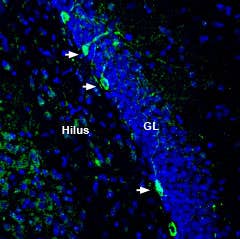
-
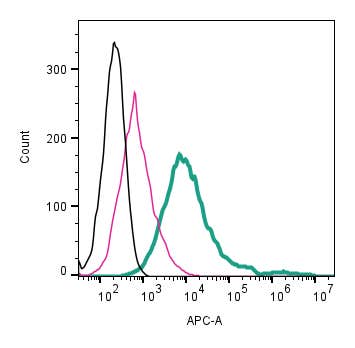 A Rabbit Polyclonal Antibody to TRPV2 (VRL1) (extracellular) conjugated to the fluorescent dye Allophycocyanin (APC)
- Product Code: ACC-039-APC
- Short Description: A Rabbit Polyclonal Antibody to TRPV2 (VRL1) (extracellular) conjugated to the fluorescent dye Allophycocyanin (APC)
- Host: Rabbit
- Label: APC
- Reactivity: Rat, Mouse
- Applications: Live cell imaging, Flow cytometry
- Target: Transient receptor potential cation channel subfamily V member 2, Vanilloid receptor-like protein 1, VRL-1, Osm-9-like TRP channel 2, OTRPC2, Stretch-activated channel 2B, SAC2B
-
 A Rabbit Polyclonal Antibody to TRPV2 (VRL1) Channel
- Product Code: ACC-039
- Short Description: A Rabbit Polyclonal Antibody to TRPV2 (VRL1) Channel
- Host: Rabbit
- Label: Unconjugated
- Reactivity: Rat, Mouse
- Applications: Indirect flow cytometry, Live cell imaging, Western blot, Immunocytochemistry, Immunofluorescence, Immunoprecipitation, Immunohistochemistry
- Target: Transient receptor potential cation channel subfamily V member 2, Vanilloid receptor-like protein 1, VRL-1, Osm-9-like TRP channel 2, OTRPC2, Stretch-activated channel 2B, SAC2B
-
 A Guinea Pig Polyclonal Antibody to TRPA1 (extracellular)
- Product Code: ACC-037-GP
- Short Description: A Guinea Pig Polyclonal Antibody to TRPA1 (extracellular)
- Host: Guinea Pig
- Label: Unconjugated
- Reactivity: Human, Rat, Mouse
- Applications: Western blot, Immunohistochemistry
- Target: Transient receptor potential cation channel subfamily A member 1, ANKTM1, Ankyrin-like with transmembrane domains protein 1, Transformation-sensitive protein p120, Wasabi Receptor
-
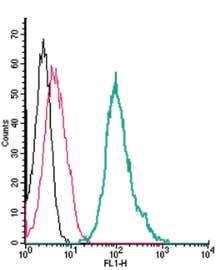 A Rabbit Polyclonal Antibody to TRPA1 (extracellular) conjugated to the fluorescent dye FITC
- Product Code: ACC-037-F
- Short Description: A Rabbit Polyclonal Antibody to TRPA1 (extracellular) conjugated to the fluorescent dye FITC
- Host: Rabbit
- Label: FITC
- Reactivity: Human, Rat, Mouse
- Applications: Flow cytometry
- Target: Transient receptor potential cation channel subfamily A member 1, ANKTM1, Ankyrin-like with transmembrane domains protein 1, Transformation-sensitive protein p120, Wasabi Receptor
-

 A Rabbit Polyclonal Antibody to TRPA1 Channel
- Product Code: ACC-037
- Short Description: A Rabbit Polyclonal Antibody to TRPA1 Channel
- Host: Rabbit
- Label: Unconjugated
- Reactivity: Human, Rat, Mouse
- Applications: Indirect flow cytometry, Live cell imaging, Western blot, Immunocytochemistry, Immunofluorescence, Immunoprecipitation, Immunohistochemistry
- Target: Transient receptor potential cation channel subfamily A member 1, ANKTM1, Ankyrin-like with transmembrane domains protein 1, Transformation-sensitive protein p120
-
 A Rabbit Polyclonal Antibody to TRPV6 Channel
- Product Code: ACC-036
- Short Description: A Rabbit Polyclonal Antibody to TRPV6 Channel
- Host: Rabbit
- Label: Unconjugated
- Reactivity: Human, Rat, Mouse
- Applications: Western blot, Immunocytochemistry, Immunofluorescence, Immunoprecipitation, Immunohistochemistry
- Target: Epithelial calcium channel 2, ECaC2, Calcium transport protein 1, CaT1, CaT-like, CaT-L, Transient receptor potential cation channel subfamily V member 6
-
 A Rabbit Polyclonal Antibody to TRPV5 Channel
- Product Code: ACC-035
- Short Description: A Rabbit Polyclonal Antibody to TRPV5 Channel
- Host: Rabbit
- Label: Unconjugated
- Reactivity: Human, Rat, Mouse
- Applications: Western blot, Immunocytochemistry, Immunofluorescence, Immunohistochemistry
- Target: Transient receptor potential cation channel subfamily V member 5, Calcium transport protein 2, CaT2, Epithelial calcium channel 1, ECaC1, OTRPC3
-
 A Guinea Pig Polyclonal Antibody to TRPV4 Channel
- Product Code: ACC-034-GP
- Short Description: A Guinea Pig Polyclonal Antibody to TRPV4 Channel
- Host: Guinea Pig
- Label: Unconjugated
- Reactivity: Mouse
- Applications: Western blot
- Target: OTRPC4, VRL-2, VR-OAC, TRP12
-
 A Rabbit Polyclonal Antibody to TRPV4 Channel Conjugated to the Fluorescent Dye ATTO-550
- Product Code: ACC-034-AO
- Short Description: A Rabbit Polyclonal Antibody to TRPV4 Channel Conjugated to the Fluorescent Dye ATTO-550
- Host: Rabbit
- Label: ATTO 550
- Reactivity: Human, Rat, Mouse
- Applications: Immunofluorescence, Immunohistochemistry
- Target: OTRPC4, VRL-2, VR-OAC, TRP12
-
 A Rabbit Polyclonal Antibody to TRPV4 Channel
- Product Code: ACC-034
- Short Description: A Rabbit Polyclonal Antibody to TRPV4 Channel
- Host: Rabbit
- Label: Unconjugated
- Reactivity: Human, Rat, Mouse
- Applications: Indirect flow cytometry, Western blot, Immunocytochemistry, Immunofluorescence, Immunoprecipitation, Immunohistochemistry
- Target: OTRPC4, VRL-2, VR-OAC, TRP12
Loading...