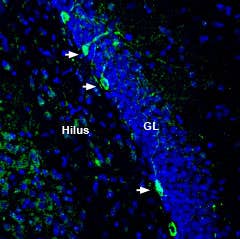
-
 A Guinea Pig Polyclonal Antibody to Cannabinoid Receptor 1 (extracellular)
- Product Code: ACR-001-GP
- Short Description: A Guinea Pig Polyclonal Antibody to Cannabinoid Receptor 1 (extracellular)
- Host: Guinea Pig
- Label: Unconjugated
- Reactivity: Human, Rat, Mouse
- Applications: Western blot, Immunohistochemistry
- Target: CB1, CB-R, CB1R, CANN6, Brain-type cannabinoid receptor, Central cannabinoid receptor, CNR1
-
 A Rabbit Polyclonal Antibody to Cannabinoid Receptor 1 Conjugated to the Fluorescent Dye FITC
- Product Code: ACR-001-F
- Short Description: A Rabbit Polyclonal Antibody to Cannabinoid Receptor 1 Conjugated to the Fluorescent Dye FITC
- Host: Rabbit
- Label: FITC
- Reactivity: Human, Rat, Mouse
- Applications: Live cell imaging, Flow cytometry
- Target: CB1, CB-R, CNR1, CB1R, CANN6, Brain-type cannabinoid receptor, Central cannabinoid receptor
-
 A Rabbit Polyclonal Antibody to Cannabinoid Receptor 1
- Product Code: ACR-001
- Short Description: A Rabbit Polyclonal Antibody to Cannabinoid Receptor 1
- Host: Rabbit
- Label: Unconjugated
- Reactivity: Human, Rat, Mouse
- Applications: Indirect flow cytometry, Live cell imaging, Western blot, Immunocytochemistry, Immunofluorescence, Immunohistochemistry
- Target: CB1, CB-R, CNR1, CB1R, CANN6, Brain-type cannabinoid receptor, Central cannabinoid receptor
-
 A Rabbit Polyclonal Antibody to SERCA2 Pump
- Product Code: ACP-012
- Short Description: A Rabbit Polyclonal Antibody to SERCA2 Pump
- Host: Rabbit
- Label: Unconjugated
- Reactivity: Human, Rat, Mouse
- Applications: Western blot, Immunocytochemistry, Immunofluorescence
- Target: Sarcoplasmic/endoplasmic reticulum calcium ATPase 2, Calcium pump 2, ATP2A2
-
 A Rabbit Polyclonal Antibody to SERCA1 Pump
- Product Code: ACP-011
- Short Description: A Rabbit Polyclonal Antibody to SERCA1 Pump
- Host: Rabbit
- Label: Unconjugated
- Reactivity: Rat, Mouse
- Applications: Western blot, Immunocytochemistry, Immunofluorescence, Immunohistochemistry
- Target: Sarcoplasmic/endoplasmic reticulum calcium ATPase 1, Calcium pump 1, ATP2A1
-
 A Rabbit Polyclonal Antibody to PMCA1 ATPase
- Product Code: ACP-005
- Short Description: A Rabbit Polyclonal Antibody to PMCA1 ATPase
- Host: Rabbit
- Label: Unconjugated
- Reactivity: Human, Rat, Mouse
- Applications: Western blot, Immunofluorescence, Immunohistochemistry
- Target: Plasma membrane Ca2+ ATPase 1, ATP2B1
-
 A Rabbit Polyclonal Antibody to PMCA4 ATPase
- Product Code: ACP-004
- Short Description: A Rabbit Polyclonal Antibody to PMCA4 ATPase
- Host: Rabbit
- Label: Unconjugated
- Reactivity: Mouse
- Applications: Western blot, Immunofluorescence, Immunohistochemistry
- Target: Plasma membrane Ca2+ ATPase 4, Matrix-Remodeling-Associated Protein 1, ATP2B4
-
 A Rabbit Polyclonal Antibody to PMCA2 ATPase
- Product Code: ACP-002
- Short Description: A Rabbit Polyclonal Antibody to PMCA2 ATPase
- Host: Rabbit
- Label: Unconjugated
- Reactivity: Rat, Mouse
- Applications: Western blot
- Target: Plasma membrane Ca2+ ATPase 2, ATP2B2
-
 A Rabbit Polyclonal Antibody to CLIC4 Channel
- Product Code: ACL-024
- Short Description: A Rabbit Polyclonal Antibody to CLIC4 Channel
- Host: Rabbit
- Label: Unconjugated
- Reactivity: Human, Rat, Mouse
- Applications: Western blot, Immunocytochemistry, Immunofluorescence
- Target: Cl- intracellular channel 4, Intracellular chloride ion channel p64H1
-
 A Rabbit Polyclonal Antibody to CLIC1 Channel
- Product Code: ACL-021
- Short Description: A Rabbit Polyclonal Antibody to CLIC1 Channel
- Host: Rabbit
- Label: Unconjugated
- Reactivity: Human, Rat, Mouse
- Applications: Western blot, Immunocytochemistry, Immunofluorescence
- Target: Cl- intracellular channel 1, Nuclear chloride ion channel 27, NCC27, Chloride channel ABP
Loading...