-

 A potent blocker/gating modifier of KV4.2 and KV4.3 channels
- Product Code: STP-710
- Short Description: A potent blocker/gating modifier of KV4.2 and KV4.3 channels
- Label: Unconjugated
- Applications: Electrophysiology
- CAS No.: 221889-63-0
- MW: 3921.7 Da
-
 A potent blocker of NaV1.2 and NaV1.6 channels
- Product Code: STP-720
- Short Description: A potent blocker of NaV1.2 and NaV1.6 channels
- Label: Unconjugated
- Applications: Electrophysiology
- CAS No.: 880886-00-0
- MW: 4058.8 Da
-
 Selective Antagonist of Various AMPA Receptors
- Product Code: P-120
- Short Description: Selective Antagonist of Various AMPA Receptors
- CAS No.: 401601-12-5
- MW: 507.54
-
 A Use-Dependent Anti-Arrhythmic NaV Channel Blocker
- Product Code: P-145
- Short Description: A Use-Dependent Anti-Arrhythmic NaV Channel Blocker
- CAS No.: 88069-49-2
- MW: 308.85
-
 A Novel Opener of KCa1.1 Channels
- Product Code: P-270
- Short Description: A Novel Opener of KCa1.1 Channels
- CAS No.: 127-27-5
- MW: 302.5
-
 A blocker of presynaptic CaV2 (CaV2.1, CaV2.2, CaV2.3) calcium channels
- Product Code: P-510
- Short Description: A blocker of presynaptic CaV2 (CaV2.1, CaV2.2, CaV2.3) calcium channels
- Label: Unconjugated
- Applications: Neurotransmitter Release Assays, Electrophysiology, Calcium imaging assay
- MW: 5108.7 Da
-
 A blocker/gating modifier of NaV, CaV3.1, KV2.1 and TRPA1 channels
- Product Code: STP-400
- Short Description: A blocker/gating modifier of NaV, CaV3.1, KV2.1 and TRPA1 channels
- Label: Unconjugated
- Applications: Electrophysiology
- CAS No.: 484598-35-8
- MW: 3987.6 Da
-
 A highly potent gating modifier of NaV1.7 channels with weaker activity on CaV3.2 T-type channels
- Product Code: STP-100
- Short Description: A highly potent gating modifier of NaV1.7 channels with weaker activity on CaV3.2 T-type channels
- Label: Unconjugated
- Applications: Electrophysiology
- CAS No.: 484598-36-9
- MW: 3826.6 Da
-
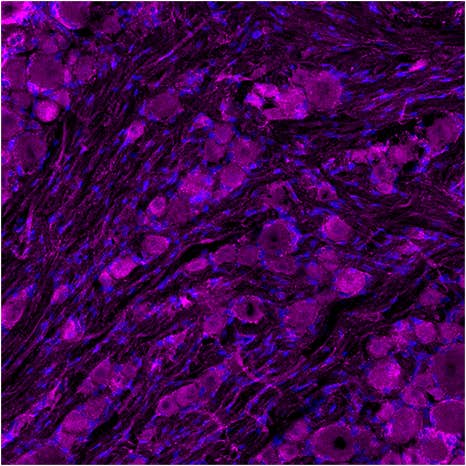 A highly potent gating modifier of NaV1.7 channels with weaker activity on CaV3.2 T-type channels conjugated to biotin
- Product Code: STP-100-B
- Short Description: A highly potent gating modifier of NaV1.7 channels with weaker activity on CaV3.2 T-type channels conjugated to biotin
- Label: Biotin
- Applications: Electrophysiology, Fluorescence staining, Immunofluorescence, Indirect flow cytometry
- MW: 4053 Da
-
 A potent blocker/gating modifier of NaV1.7 channels
- Product Code: STP-150
- Short Description: A potent blocker/gating modifier of NaV1.7 channels
- Label: Unconjugated
- Applications: Electrophysiology
- MW: 3802.5 Da
Loading...