

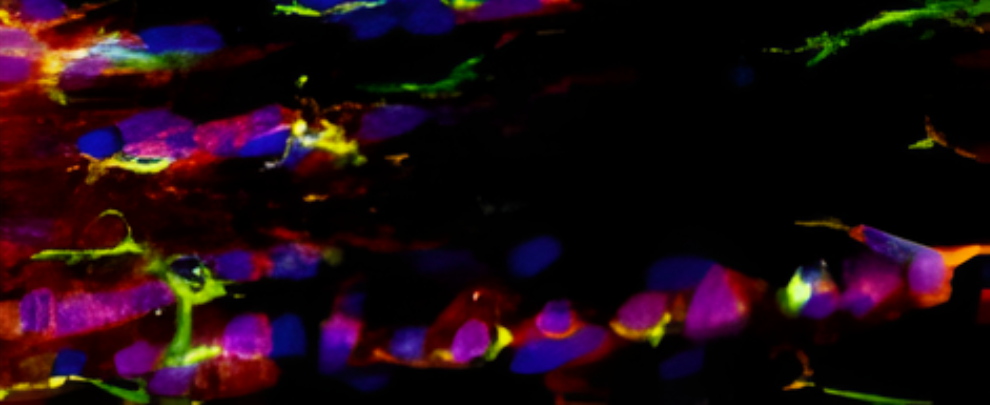
Identifying new treatments for neurodegenerative disease, particularly those relating to motor neurons, is a major focus and a serious challenge for a lot of scientists. One of the more recent and interesting therapeutic targets is the P2X7 receptor (P2X7R), an ion channel activated by abnormally high levels of extracellular ATP. While a lot of work has already been done in non-neuronal cells like astrocytes and microglia, its role in human motor neurons has been largely unexplored. A team from Johns Hopkins University decided to look into this using human induced pluripotent stem cell-derived motor neurons (hiPSC-MNs), where they describe the destructive potential of P2X7R and the promise of its inhibition as a neuroprotective strategy (1).
A Unique Ion Channel with Pathological Potential
P2X7R has previously attracted attention in non-neuronal cells like astrocytes and microglia (2), but it’s role in human motor neurons is less understood. P2X7R, unlike other ATP-sensitive receptors, only activates at the high ATP concentrations often found in disease states. Once triggered, it forms a non-selective pore that can disrupt cellular integrity, triggering a cellular cascade leading to apoptosis and neuroinflammation. The study here revealed that P2X7R is expressed across hiPSC-MNs and that its activation by ATP directly induces motor neuron death in a dose-dependent manner.
Two Antibodies, Two Perspectives
To better understand P2X7R’s role, researchers used two distinct antibodies: one targeting the extracellular domain (Anti-P2X7 Receptor (extracellular) Antibody (#APR-008)) and another binding intracellularly (Anti-P2X7 Receptor Antibody (#APR-004)). These antibodies confirmed P2X7R expression and revealed distinct differences in staining patterns (Figure 1).
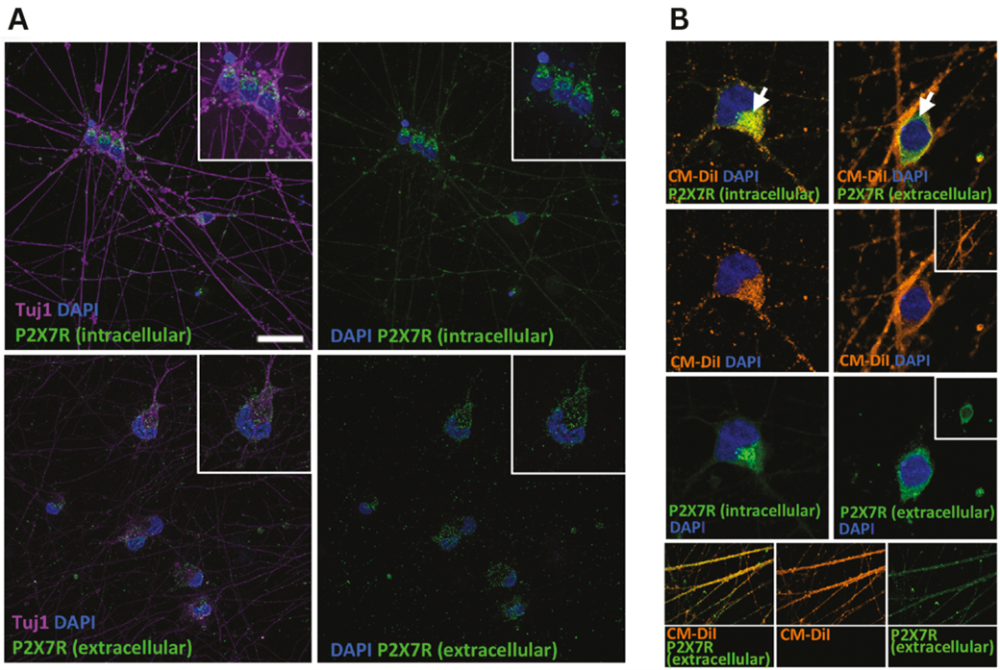
Figure 1. P2X7R expression on spinal hiPSC-MN with intracellular compared to extracellular epitope-directed antibodies. (A) Immunohistochemical labeling of spinal hiPSC-MN with P2X7R antibodies directed to either an intracellular or extracellular portion of P2X7R showing differential staining patterns. Scale bar = 20 μm. (B) Confocal imaging comparing extracellular and intracellular epitope-directed P2X7R antibodies relative to DiI-labeled membranes on hiPSC-MN. Image taken from Johns et al. (2024), https://doi.org/10.1093/stcltm/szae074. Licensed under Creative Commons Attribution 4.0 International (CC BY 4.0).
It was clear from their immunocytochemistry, that P2X7R was expressed in both membrane-bound and intracellular compartments, showing its functional significance in ATP-mediated neuronal death. These assays neatly show the utility of using both antibodies to comprehensively characterize P2X7R expression and activity in motor neurons.
Neuroprotection via P2X7R Inhibition
The study’s key experiment involved treating hiPSC-MNs with a specific P2X7R antagonist (JNJ-47965567) under high ATP conditions. The treatment effectively reduced intracellular calcium influx and caspase-3 activation – two key indicators of cellular stress and apoptosis. These results are compelling evidence that blocking P2X7R can mitigate motor neuron death, which is major step towards neuroprotective therapies that target this pathway.
Implications for Antibody Development and Disease Research
P2X7R antibodies were central to this research as it allowed for accurate receptor mapping and functional studies. For researchers and pharmaceutical developers, these findings emphasize the importance of reliable, specific antibodies when studying therapeutic targets.
The discovery that extracellular ATP directly induces motor neuron death via P2X7R activation not only tells us more about motor neuron diseases but also identifies a clear therapeutic target. With antibodies capable of differentiating intra- and extracellular protein distribution, researchers can look more closely into the intricate biology of receptors like P2X7R.

