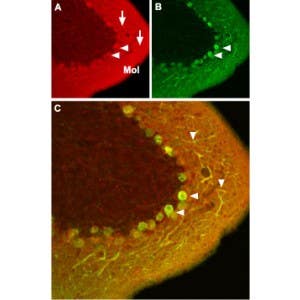
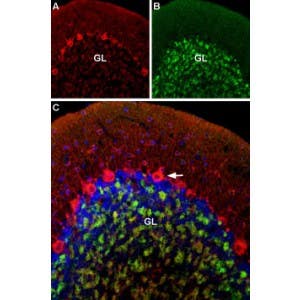
-
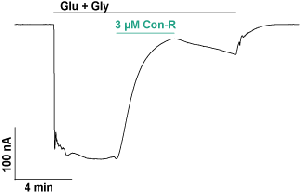
 A potent, competitive antagonist of NMDARs containing either the GluN2A or GluN2B receptor subunit
- Product Code: STC-777
- Applications: Electrophysiology
- CAS No.: 202925-60-8
- MW: 3098 Da
Loading...
Login with SMS Code
Enter your email address. We'll send a verification code to your registered mobile phone.
Enter the 6-digit code sent to the phone registered to your account.
Code expires in
Checkout as a new customer
Creating an account has many benefits:
Engineered venom-derived peptide toxins designed for high-specificity ion channel research and reproducible experimental performance.
Our toxins are developed in-house using controlled synthesis, folding, and multistep purification workflows that eliminate non-specific components found in crude venom. Each peptide is validated by HPLC, mass spectrometry, and functional bioassays, for lot-to-lot consistency and reliable performance. Available in synthetic, recombinant, native, and optionally fluorophore-conjugated formats. These reagents enable precise functional electrophysiology, imaging, and live-cell studies across neuronal systems.
Lorem ipsum dolor sit amet, consectetur adipiscing elit. Curabitur quis risus id enim vehicula interdum et ac sem.
The expected molecular weight (MW) listed in the product datasheet is based solely on the size of the target protein’s amino acid sequence. It’s important to remember that many factors can affect the banding pattern of your western blot including: (1) the existence of a splice variant, (2) the quality of the loaded sample, (3) the protein extraction method, and (4) the protein transfer conditions. To achieve accurate results, you may need to systematically adjust the protein extraction method or the protein transfer conditions.
Some toxins and peptides are soluble in DMSO; you can find this information in the product specification section. For these products, prepare a concentrated stock solution first.
Note: We recommend that you maintain a DMSO concentration as low as possible. For cell assays, a final concentration of 0.1–0.5% DMSO (v/v) is considered acceptable. For other experiments, 5% DMSO (v/v) is recommended; adjust this according to your experimental requirements.
FAQ 3FAQ 3FAQ 3FAQ 3