-
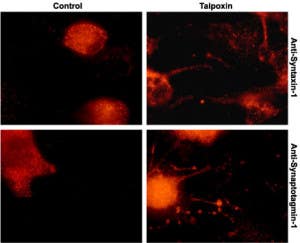
 A blocker of synaptic vesicle recycling
- Product Code: T-460
- Short Description: A blocker of synaptic vesicle recycling
- Applications: Neurite outgrowth assay, Immunocytochemistry
- CAS No.: 52019-39-3
- MW: 46 kDa
-
 An inhibitor of neurotransmitter release
- Product Code: T-150
- Short Description: An inhibitor of neurotransmitter release
- Applications: Cell-Based Assays, Synaptic Transmission Assays, Western blot
- CAS No.: 676570-37-9
- MW: 150 kDa
-
 An Endogenous Partial Agonist of Glycine Receptors and Taurine Transporters
- Product Code: T-130
- Short Description: An Endogenous Partial Agonist of Glycine Receptors and Taurine Transporters
- CAS No.: 107-35-7
- MW: 125.15
-
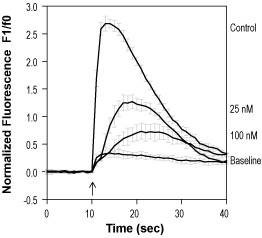 A negative allosteric modulator (NAM) of the M1 Muscarinic Receptor
- Product Code: STM-200
- Short Description: A negative allosteric modulator (NAM) of the M1 Muscarinic Receptor
- Applications: Electrophysiology
- CAS No.: 135541-77-4
- MW: 7472.5 Da
-
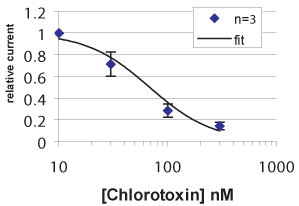 A potent scorpion toxin that preferentially binds to tumor cells by targeting multiple receptors including chloride channels,MMP-2, and Neuropilin-1
- Product Code: STC-460
- Applications: Cell-Based Assays, Electrophysiology, Calcium imaging assay
- CAS No.: 163515-35-3
- MW: 3995.8 Da
-
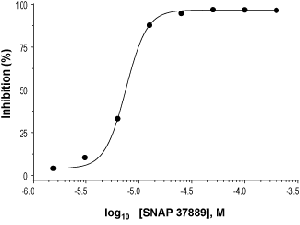 A Selective Antagonist of Galanin 3 Receptor
- Product Code: S-210
- Short Description: A Selective Antagonist of Galanin 3 Receptor
- CAS No.: 303149-14-6
- MW: 366.34
-
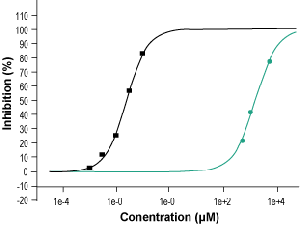 An Agonist of Glycine Receptors
- Product Code: S-135
- Short Description: An Agonist of Glycine Receptors
- CAS No.: 56-45-1
- MW: 105.1
-
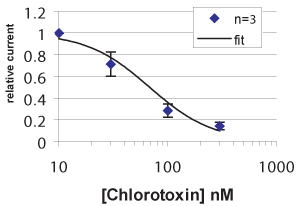 A potent scorpion toxin that preferentially binds to tumor cells by targeting multiple receptors including chloride channels,MMP-2, and Neuropilin-1
- Product Code: RTC-450
- Applications: Cell-Based Assays, Electrophysiology, Calcium imaging assay
- CAS No.: 163515-35-3
- MW: 3996.7 Da
-
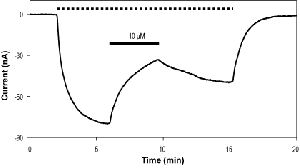 An Antagonist of GABA(A), Glycine, and 5-HT3 Receptors
- Product Code: P-325
- CAS No.: 124-87-8
- MW: 602.58
-
A channel-forming neurotoxin (ionophore) that induces neurotransmitter release through both calcium-dependent and calcium-independent mechanisms
- Product Code: P-300
- Short Description: A channel-forming neurotoxin (ionophore) that induces neurotransmitter release through both calcium-dependent and calcium-independent mechanisms
- Applications: Membrane Permeability Assays, Vesicle Release Assays, Calcium imaging assay
- CAS No.: 67995-63-5
- MW: 3382 Da
Loading...