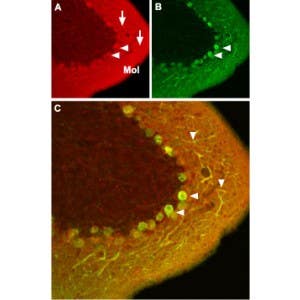
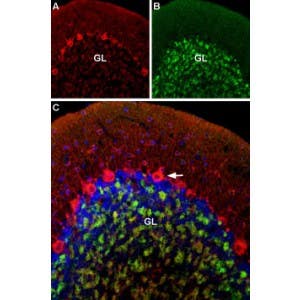
-
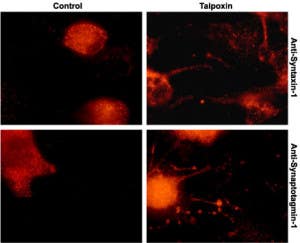
 A blocker of synaptic vesicle recycling
- Product Code: T-460
- Short Description: A blocker of synaptic vesicle recycling
- Applications: Neurite outgrowth assay, Immunocytochemistry
- CAS No.: 52019-39-3
- MW: 46 kDa
-
 An inhibitor of neurotransmitter release
- Product Code: T-150
- Short Description: An inhibitor of neurotransmitter release
- Applications: Cell-Based Assays, Synaptic Transmission Assays, Western blot
- CAS No.: 676570-37-9
- MW: 150 kDa
-
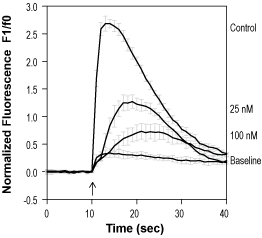 A negative allosteric modulator (NAM) of the M1 Muscarinic Receptor
- Product Code: STM-200
- Short Description: A negative allosteric modulator (NAM) of the M1 Muscarinic Receptor
- Applications: Electrophysiology
- CAS No.: 135541-77-4
- MW: 7472.5 Da
-
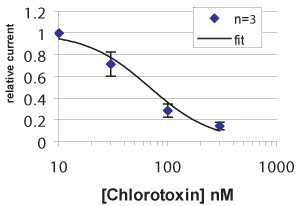 A potent scorpion toxin that preferentially binds to tumor cells by targeting multiple receptors including chloride channels,MMP-2, and Neuropilin-1
- Product Code: STC-460
- Applications: Cell-Based Assays, Electrophysiology, Calcium imaging assay
- CAS No.: 163515-35-3
- MW: 3995.8 Da
-
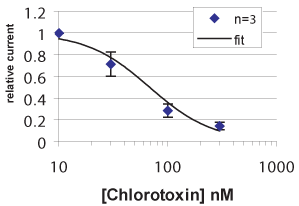 A potent scorpion toxin that preferentially binds to tumor cells by targeting multiple receptors including chloride channels,MMP-2, and Neuropilin-1
- Product Code: RTC-450
- Applications: Cell-Based Assays, Electrophysiology, Calcium imaging assay
- CAS No.: 163515-35-3
- MW: 3996.7 Da
-
A channel-forming neurotoxin (ionophore) that induces neurotransmitter release through both calcium-dependent and calcium-independent mechanisms
- Product Code: P-300
- Short Description: A channel-forming neurotoxin (ionophore) that induces neurotransmitter release through both calcium-dependent and calcium-independent mechanisms
- Applications: Membrane Permeability Assays, Vesicle Release Assays, Calcium imaging assay
- CAS No.: 67995-63-5
- MW: 3382 Da
-
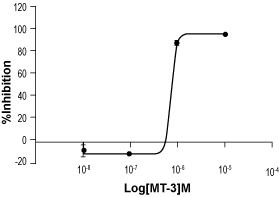 A potent antagonist selective for the M4 muscarinic acetylcholine receptor (M4 mAChR) and a non-selective antagonist for several α1- and α2-adrenoceptor subtypes
- Product Code: M-140
- Short Description: A potent antagonist selective for the M4 muscarinic acetylcholine receptor (M4 mAChR) and a non-selective antagonist for several α1- and α2-adrenoceptor subtypes
- Applications: Calcium imaging assay
- MW: 7379 Da
-
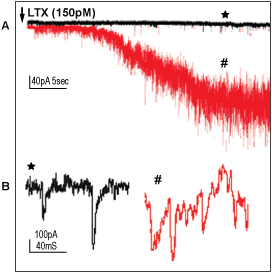 A potent inducer of massive neurotransmitter release via presynaptic neurexin and latrophilin receptors
- Product Code: LSP-130
- Short Description: A potent inducer of massive neurotransmitter release via presynaptic neurexin and latrophilin receptors
- Applications: Electrophysiology, Synaptic recording
- CAS No.: 65988-34-3
- MW: 130 kDa
-
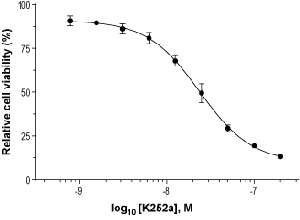 A Potent Inhibitor of Protein Kinase A, Protein Kinase C, and Protein Kinase G
- Product Code: K-150
- CAS No.: 97161-97-2
- MW: 467.5
-
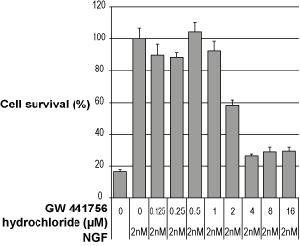 A Potent Inhibitor of TrkA
- Product Code: G-191
- Short Description: A Potent Inhibitor of TrkA
- CAS No.: 504433-24-3
- MW: 311.8
Loading...