-
 A Guinea Pig Polyclonal Antibody to CaV1.3 (CACNA1D) Channel
- Product Code: ACC-005-GP
- Short Description: A Guinea Pig Polyclonal Antibody to CaV1.3 (CACNA1D) Channel
- Host: Guinea Pig
- Label: Unconjugated
- Reactivity: Human, Rat, Mouse
- Applications: Western blot, Immunofluorescence, Immunohistochemistry
- Target: Voltage-dependent L-type calcium channel subunit α1D
-
 A Guinea Pig Polyclonal Antibody to Connexin-43
- Product Code: ACC-201-GP
- Short Description: A Guinea Pig Polyclonal Antibody to Connexin-43
- Host: Guinea Pig
- Label: Unconjugated
- Reactivity: Human, Rat, Mouse
- Applications: Western blot, Immunofluorescence, Immunohistochemistry
- Target: CX43, Gap junction α1 protein, GJA1, GJAL, Gap junction 43 kDa heart protein
-
 A Guinea Pig Polyclonal Antibody to Excitatory Amino Acid Transporter 2 (EAAT2, GLT-1)
- Product Code: AGC-022-GP
- Short Description: A Guinea Pig Polyclonal Antibody to Excitatory Amino Acid Transporter 2 (EAAT2, GLT-1)
- Host: Guinea Pig
- Label: Unconjugated
- Reactivity: Human, Rat, Mouse
- Applications: Western blot, Immunohistochemistry
- Target: Excitatory amino acid transporter 2, Sodium-dependent glutamate/aspartate transporter 2, Glutamate/Aspartate Transporter II, Solute Carrier Family 1 Member 2, SLC1A2
-
 A Guinea Pig Polyclonal Antibody to EMR1
- Product Code: AER-051-GP
- Short Description: A Guinea Pig Polyclonal Antibody to EMR1
- Host: Guinea Pig
- Label: Unconjugated
- Reactivity: Human, Rat, Mouse
- Applications: Western blot
- Target: MR1 hormone receptor, EGF-like module-containing mucin-like hormone receptor-like 1, Adhesion G protein-coupled receptor E1, TM7LN3, F4/80, GPF480
-
 A Guinea Pig Polyclonal Antibody to GAP43
- Product Code: ANR-016-GP
- Short Description: A Guinea Pig Polyclonal Antibody to GAP43
- Host: Guinea Pig
- Label: Unconjugated
- Reactivity: Human, Rat, Mouse
- Applications: Western blot, Immunohistochemistry
- Target: Axonal membrane protein GAP-43, Growth-associated protein 43, Neuromodulin, Neural phosphoprotein B-50
-
 A Guinea Pig Polyclonal Antibody to Glial Fibrillary Acidic Protein
- Product Code: AFP-001-GP
- Short Description: A Guinea Pig Polyclonal Antibody to Glial Fibrillary Acidic Protein
- Host: Guinea Pig
- Label: Unconjugated
- Reactivity: Rat, Mouse
- Applications: Western blot, Immunohistochemistry
- Target: Glial fibrillary acidic protein
-
 A Guinea Pig Polyclonal Antibody to IBA1/AIF1
- Product Code: ACS-010-GP
- Short Description: A Guinea Pig Polyclonal Antibody to IBA1/AIF1
- Host: Guinea Pig
- Label: Unconjugated
- Reactivity: Human, Rat, Mouse
- Applications: Western blot, Immunohistochemistry
- Target: Ionized calcium-binding adapter molecule 1, Allograft Inflammatory Factor 1, MRF-1, Microglia response factor
-
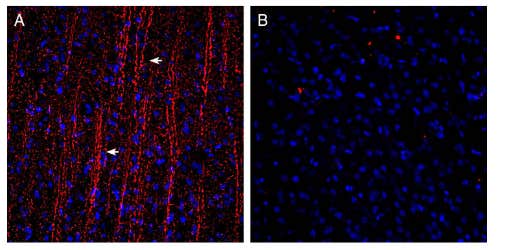 A Guinea Pig Polyclonal Antibody to P2Y12 Receptor
- Product Code: APR-020-GP
- Short Description: A Guinea Pig Polyclonal Antibody to P2Y12 Receptor
- Host: Guinea Pig
- Label: Unconjugated
- Reactivity: Human, Rat, Mouse
- Applications: Live cell imaging, Western blot, Immunocytochemistry, Immunofluorescence, Immunohistochemistry
- Target: P2Y purinoceptor 12, P2RY12, ADP-glucose receptor, Platelet ADP receptor, HORK3
-
 A Guinea Pig Polyclonal Antibody to Periaxin
- Product Code: ANR-091-GP
- Short Description: A Guinea Pig Polyclonal Antibody to Periaxin
- Host: Guinea Pig
- Label: Unconjugated
- Reactivity: Human, Rat, Mouse
- Applications: Western blot, Immunohistochemistry
- Target: PRX, CMT4F
-
 A Guinea Pig Polyclonal Antibody to proBDNF
- Product Code: ANT-006-GP
- Short Description: A Guinea Pig Polyclonal Antibody to proBDNF
- Host: Guinea Pig
- Label: Unconjugated
- Reactivity: Human, Rat
- Applications: Western blot, Immunofluorescence, Immunohistochemistry
- Target: Brain-derived neurotrophic factor precursor
Loading...