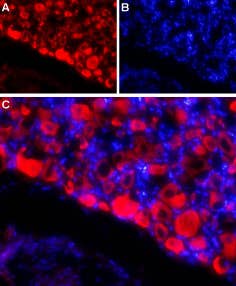
-

 A potent cardiotoxin that delays the inactivation of NaV channels
- Product Code: STA-400
- Short Description: A potent cardiotoxin that delays the inactivation of NaV channels
- Applications: Electrophysiology
- MW: 4877.6 Da
-
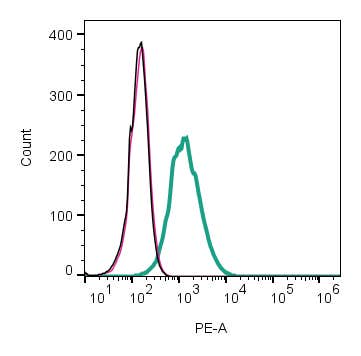 A Rabbit Polyclonal Antibody to ACVRL1
- Product Code: ABR-041
- Short Description: A Rabbit Polyclonal Antibody to ACVRL1
- Host: Rabbit
- Label: Unconjugated
- Reactivity: Rat, Mouse
- Applications: Indirect flow cytometry, Live cell imaging, Western blot
- Target: Activin A Receptor Like Type 1, ALK1, Serine/Threonine-Protein Kinase Receptor R3, SKR3, TGF-B Superfamily Receptor Type I, TSR-I
-
 A Rabbit Polyclonal Antibody to Aquaporin 2 Channel
- Product Code: AQP-002
- Short Description: A Rabbit Polyclonal Antibody to Aquaporin 2 Channel
- Host: Rabbit
- Label: Unconjugated
- Reactivity: Human, Rat, Mouse
- Applications: Western blot, Immunocytochemistry, Immunohistochemistry
- Target: AQP2, AQP-CD, WCH-CD
-
 A Rabbit Polyclonal Antibody to Aquaporin 2 Conjugated to the Fluorescent Dye ATTO-550
- Product Code: AQP-002-AO
- Short Description: A Rabbit Polyclonal Antibody to Aquaporin 2 Conjugated to the Fluorescent Dye ATTO-550
- Host: Rabbit
- Label: ATTO 550
- Reactivity: Human, Rat, Mouse
- Applications: Immunocytochemistry, Immunofluorescence, Immunohistochemistry
- Target: AQP2, AQP-CD, WCH-CD
-
 A Rabbit Polyclonal Antibody to CACNB2 (CaVβ2) Subunit
- Product Code: ACC-105
- Short Description: A Rabbit Polyclonal Antibody to CACNB2 (CaVβ2) Subunit
- Host: Rabbit
- Label: Unconjugated
- Reactivity: Rat, Mouse
- Applications: Western blot, Immunohistochemistry
- Target: CaVβ2, Voltage-dependent L-type calcium channel subunit beta-2, CACNLB2, CAB2, CACB2, Lambert-Eaton myasthenic syndrome antigen B, MYSB
-
 A Rabbit Polyclonal Antibody to CACNB2 (CaVβ2) Conjugated to the Fluorescent Dye ATTO-594
- Product Code: ACC-105-AR
- Short Description: A Rabbit Polyclonal Antibody to CACNB2 (CaVβ2) Conjugated to the Fluorescent Dye ATTO-594
- Host: Rabbit
- Label: ATTO 594
- Reactivity: Rat, Mouse
- Applications: Immunofluorescence, Immunohistochemistry
- Target: CaVβ2, Voltage-dependent L-type calcium channel subunit beta-2, CACNLB2, CAB2, CACB2, Lambert-Eaton myasthenic syndrome antigen B, MYSB
-
 A Rabbit Polyclonal Antibody to CACNB3 (CaV?3) Subunit
- Product Code: ACC-008
- Short Description: A Rabbit Polyclonal Antibody to CACNB3 (CaV?3) Subunit
- Host: Rabbit
- Label: Unconjugated
- Reactivity: Human, Rat, Mouse
- Applications: Western blot, Immunocytochemistry, Immunofluorescence, Immunohistochemistry
- Target: CaVβ3, CAB3, CACNLB3, Voltage-dependent L-type calcium channel subunit beta-3
-
 A Rabbit Polyclonal antibody to CaV1.2 (extracellular)
- Product Code: ACC-130
- Short Description: A Rabbit Polyclonal antibody to CaV1.2 (extracellular)
- Host: Rabbit
- Label: Unconjugated
- Reactivity: Human, Rat, Mouse
- Applications: Indirect flow cytometry, Live cell imaging, Western blot, Immunohistochemistry
- Target: Voltage-dependent L-type calcium channel subunit alpha-1C, Calcium Voltage-Gated Channel Subunit Alpha1C
-

 A Rabbit Polyclonal Antibody to CaV1.2 (CACNA1C) Channel
- Product Code: ACC-003
- Short Description: A Rabbit Polyclonal Antibody to CaV1.2 (CACNA1C) Channel
- Host: Rabbit
- Label: Unconjugated
- Reactivity: Human, Rat, Mouse
- Applications: Indirect flow cytometry, Western blot, Immunocytochemistry, Immunofluorescence, Immunohistochemistry
- Target: Voltage-dependent L-type calcium channel subunit α1C
-
 A Rabbit Polyclonal Antibody to CaV1.2 (CACNA1C) Channel Conjugated to the Fluorescent Dye ATTO-488
- Product Code: ACC-003-AG
- Short Description: A Rabbit Polyclonal Antibody to CaV1.2 (CACNA1C) Channel Conjugated to the Fluorescent Dye ATTO-488
- Host: Rabbit
- Label: ATTO 488
- Reactivity: Human, Rat, Mouse
- Applications: Immunocytochemistry, Immunofluorescence, Immunohistochemistry
- Target: Voltage-dependent L-type calcium channel subunit α1C
Loading...