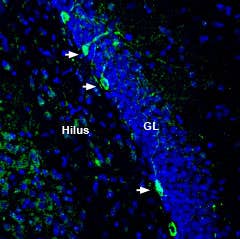
-
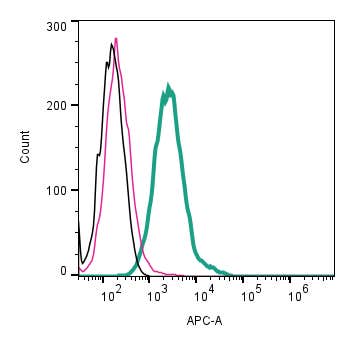 A Rabbit Polyclonal Antibody to Piezo1 (extracellular) conjugated to the fluorescent dye Allophycocyanin (APC)
- Product Code: APC-087-APC
- Short Description: A Rabbit Polyclonal Antibody to Piezo1 (extracellular) conjugated to the fluorescent dye Allophycocyanin (APC)
- Host: Rabbit
- Label: APC
- Reactivity: Rat, Mouse
- Applications: Live cell imaging, Flow cytometry
- Target: Piezo-type mechanosensitive ion channel component 1, Protein FAM38A, Mib, Membrane protein induced by beta-amyloid treatment
-

 A Rabbit Polyclonal Antibody to Piezo1 Channel
- Product Code: APC-087
- Short Description: A Rabbit Polyclonal Antibody to Piezo1 Channel
- Host: Rabbit
- Label: Unconjugated
- Reactivity: Rat, Mouse
- Applications: Indirect flow cytometry, Live cell imaging, Western blot, Immunofluorescence, Immunohistochemistry
- Target: Piezo-type mechanosensitive ion channel component 1, Protein FAM38A, Mib, Membrane protein induced by beta-amyloid treatment
-
 A Rabbit Polyclonal Antibody to LRRC26
- Product Code: APC-070
- Short Description: A Rabbit Polyclonal Antibody to LRRC26
- Host: Rabbit
- Label: Unconjugated
- Reactivity: Rat, Mouse
- Applications: Western blot
- Target: Leucine-rich repeat-containing protein 26, BK channel auxiliary gamma subunit LRRC26, Cytokeratin-associated protein in cancer, CAPC
-
 A Rabbit Polyclonal Antibody to KCNN4 (KCa3.1, SK4) Channel
- Product Code: APC-064
- Short Description: A Rabbit Polyclonal Antibody to KCNN4 (KCa3.1, SK4) Channel
- Host: Rabbit
- Label: Unconjugated
- Reactivity: Human, Rat, Mouse
- Applications: Western blot, Immunocytochemistry, Immunofluorescence, Immunoprecipitation, Immunohistochemistry
- Target: IKCa1, IK1, Intermediate conductance Ca2+-activated K+ channel protein 4, Gardos channel
-
 A Rabbit Polyclonal Antibody to KV11.1 Channel
- Product Code: APC-062
- Short Description: A Rabbit Polyclonal Antibody to KV11.1 Channel
- Host: Rabbit
- Label: Unconjugated
- Reactivity: Human, Rat, Mouse
- Applications: Western blot, Immunocytochemistry, Immunofluorescence, Immunoprecipitation, Immunohistochemistry
- Target: KV11.1, Potassium voltage-gated channel subfamily H member 2, Ether-a-go-go-related channel 1
-
 A Guinea Pig Polyclonal Antibody to HCN1 Channel
- Product Code: APC-056-GP
- Short Description: A Guinea Pig Polyclonal Antibody to HCN1 Channel
- Host: Guinea Pig
- Label: Unconjugated
- Reactivity: Mouse
- Applications: Western blot, Immunofluorescence, Immunohistochemistry
- Target: Hyperpolarization-activated cyclic nucleotide-gated potassium channel 1, HAC2, Brain cyclic nucleotide-gated channel 1, BCNG1, Potassium/sodium hyperpolarization-activated cyclic nucleotide-gated channel 1
-
 A Rabbit Polyclonal Antibody to HCN1 Channel
- Product Code: APC-056
- Short Description: A Rabbit Polyclonal Antibody to HCN1 Channel
- Host: Rabbit
- Label: Unconjugated
- Reactivity: Human, Rat, Mouse
- Applications: Western blot, Immunocytochemistry, Immunofluorescence, Immunohistochemistry
- Target: Hyperpolarization-activated cyclic nucleotide-gated potassium channel 1, HAC2, Brain cyclic nucleotide-gated channel 1, BCNG1, Potassium/sodium hyperpolarization-activated cyclic nucleotide-gated channel 1
-
 A Rabbit Polyclonal Antibody to KCNE2 (MiRP1) Subunit
- Product Code: APC-054
- Short Description: A Rabbit Polyclonal Antibody to KCNE2 (MiRP1) Subunit
- Host: Rabbit
- Label: Unconjugated
- Reactivity: Human, Rat, Mouse
- Applications: Western blot, Immunocytochemistry, Immunofluorescence, Immunoprecipitation, Immunohistochemistry
- Target: Potassium channel subunit β MiRP1, MinK-related peptide 1, Potassium voltage-gated channel subfamily E member 2
-
 A Guinea Pig Polyclonal Antibody to HCN4 Channel
- Product Code: APC-052-GP
- Short Description: A Guinea Pig Polyclonal Antibody to HCN4 Channel
- Host: Guinea Pig
- Label: Unconjugated
- Reactivity: Human, Rat, Mouse
- Applications: Western blot, Immunofluorescence, Immunohistochemistry
- Target: Hyperpolarization-activated cyclic nucleotide-gated potassium channel 4
-
 A Rabbit Polyclonal Antibody to HCN4 Channel
- Product Code: APC-052
- Short Description: A Rabbit Polyclonal Antibody to HCN4 Channel
- Host: Rabbit
- Label: Unconjugated
- Reactivity: Human, Rat, Mouse
- Applications: Western blot, Immunocytochemistry, Immunofluorescence, Immunoprecipitation, Immunohistochemistry
- Target: Hyperpolarization-activated cyclic nucleotide-gated potassium channel 4
Loading...