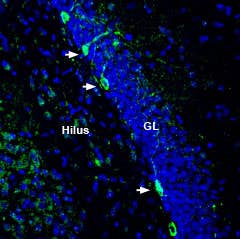
-
 A Rabbit Polyclonal Antibody to NaV1.7 (SCN9A) Channel Conjugated to the Fluorescent Dye ATTO-633
- Product Code: ASC-008-FR
- Short Description: A Rabbit Polyclonal Antibody to NaV1.7 (SCN9A) Channel Conjugated to the Fluorescent Dye ATTO-633
- Host: Rabbit
- Label: ATTO 633
- Reactivity: Human, Rat, Mouse
- Applications: Immunofluorescence, Immunohistochemistry
- Target: Voltage-gated sodium channel type IX subunit alpha, PN1, NENA, NE, ETHA
-
 A Rabbit Polyclonal Antibody to SCN3A (NaV1.3) Channel
- Product Code: ASC-004
- Short Description: A Rabbit Polyclonal Antibody to SCN3A (NaV1.3) Channel
- Host: Rabbit
- Label: Unconjugated
- Reactivity: Human, Rat, Mouse
- Applications: Western blot, Immunocytochemistry, Immunofluorescence, Immunoprecipitation, Immunohistochemistry
- Target: BIII, Brain type III Na+ channel, Sodium channel protein type 3 subunit alpha
-
 A Guinea Pig Polyclonal Antibody to Pan NaV Channel
- Product Code: ASC-003-GP
- Short Description: A Guinea Pig Polyclonal Antibody to Pan NaV Channel
- Host: Guinea Pig
- Label: Unconjugated
- Reactivity: Human, Rat, Mouse
- Applications: Western blot
- Target: Pan sodium channel, SP19
-
 A Rabbit Polyclonal Antibody to Pan NaV Channel
- Product Code: ASC-003
- Short Description: A Rabbit Polyclonal Antibody to Pan NaV Channel
- Host: Rabbit
- Label: Unconjugated
- Reactivity: Human, Rat, Mouse
- Applications: Western blot, Immunocytochemistry, Immunofluorescence, Immunoprecipitation, Immunohistochemistry
- Target: Pan sodium channel, SP19
-
 A Guinea Pig Polyclonal Antibody to SCN1A (NaV1.1) Channel
- Product Code: ASC-001-GP
- Short Description: A Guinea Pig Polyclonal Antibody to SCN1A (NaV1.1) Channel
- Host: Guinea Pig
- Label: Unconjugated
- Reactivity: Human, Rat, Mouse
- Applications: Western blot
- Target: Brain type I sodium channel, BI, Sodium channel protein type 1 subunit α
-

 A Rabbit Polyclonal Antibody to SCN1A (NaV1.1) Channel Conjugated to the Fluorescent Dye ATTO-594
- Product Code: ASC-001-AR
- Short Description: A Rabbit Polyclonal Antibody to SCN1A (NaV1.1) Channel Conjugated to the Fluorescent Dye ATTO-594
- Host: Rabbit
- Label: ATTO 594
- Reactivity: Human, Rat, Mouse
- Applications: Immunofluorescence, Immunohistochemistry
- Target: Brain type I sodium channel, BI, Sodium channel protein type 1 subunit α
-
 A Rabbit Polyclonal Antibody to RAMP2
- Product Code: ARR-022
- Short Description: A Rabbit Polyclonal Antibody to RAMP2
- Host: Rabbit
- Label: Unconjugated
- Reactivity: Rat, Mouse
- Applications: Indirect flow cytometry, Live cell imaging, Western blot
- Target: Receptor activity-modifying protein 2, CRLR activity-modifying protein 2, Calcitonin receptor-like receptor activity-modifying protein 2
-
 A Rabbit Polyclonal Antibody to RAMP1
- Product Code: ARR-021
- Short Description: A Rabbit Polyclonal Antibody to RAMP1
- Host: Rabbit
- Label: Unconjugated
- Reactivity: Rat, Mouse
- Applications: Indirect flow cytometry, Live cell imaging, Western blot, Immunocytochemistry, Immunofluorescence, Immunohistochemistry
- Target: Receptor activity-modifying protein 1, Calcitonin receptor-like receptor activity-modifying protein 1
-
 A Rabbit Polyclonal Antibody to Ryanodine Receptor 3
- Product Code: ARR-003
- Short Description: A Rabbit Polyclonal Antibody to Ryanodine Receptor 3
- Host: Rabbit
- Label: Unconjugated
- Reactivity: Human, Rat, Mouse
- Applications: Western blot, Immunocytochemistry, Immunofluorescence, Immunohistochemistry
- Target: RyR3, Brain-type ryanodine receptor
-
 A Rabbit Polyclonal Antibody to Ryanodine Receptor 1
- Product Code: ARR-001
- Short Description: A Rabbit Polyclonal Antibody to Ryanodine Receptor 1
- Host: Rabbit
- Label: Unconjugated
- Reactivity: Human, Rat, Mouse
- Applications: Western blot, Immunocytochemistry, Immunofluorescence, Immunohistochemistry
- Target: RyR1, Skeletal muscle-type ryanodine receptor
Loading...