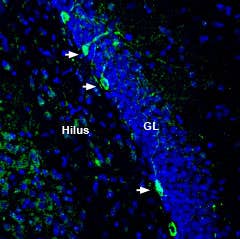
-
 A Mouse Monoclonal Antibody to Rat Neurotrophin Receptor p75NTR Conjugated to the Fluorescent Dye FITC
- Product Code: AN-170-F
- Short Description: A Mouse Monoclonal Antibody to Rat Neurotrophin Receptor p75NTR Conjugated to the Fluorescent Dye FITC
- Host: Mouse
- Label: FITC
- Reactivity: Rat
- Applications: Flow cytometry
- Target: p75NTR, NGFR p75, TNFR superfamily member 16, TNFRSF16, CD271
-
 A Mouse Monoclonal Antibody to Rat Neurotrophin Receptor p75NTR
- Product Code: AN-170
- Short Description: A Mouse Monoclonal Antibody to Rat Neurotrophin Receptor p75NTR
- Host: Mouse
- Label: Unconjugated
- Reactivity: Rat
- Applications: Indirect flow cytometry, Western blot, Immunofluorescence, Immunohistochemistry
- Target: p75NTR, NGFR p75, TNFR superfamily member 16, TNFRSF16, CD271
-
 A Rabbit Polyclonal Antibody to ABCB4/MDR3
- Product Code: AMT-023
- Short Description: A Rabbit Polyclonal Antibody to ABCB4/MDR3
- Host: Rabbit
- Label: Unconjugated
- Reactivity: Rat, Mouse
- Applications: Western blot
- Target: ATP binding cassette subfamily B member 4, Multidrug resistance protein 3, P-glycoprotein 2, Pgy2
-
 A Rabbit Polyclonal Antibody to Multidrug Resistance Protein 1
- Product Code: AMT-021
- Short Description: A Rabbit Polyclonal Antibody to Multidrug Resistance Protein 1
- Host: Rabbit
- Label: Unconjugated
- Reactivity: Human
- Applications: Western blot
- Target: Multidrug resistance protein 1, ATP-binding cassette sub-family B (MDR/TAP) member 1, P-glycoprotein 1, P-gp, PGY1, ABC20, CD243, CLCS, Colchicin sensitivity, Doxorubicin resistance, GP170
-
 A Rabbit Polyclonal Antibody to Monocarboxylate Transporter 4
- Product Code: AMT-014
- Short Description: A Rabbit Polyclonal Antibody to Monocarboxylate Transporter 4
- Host: Rabbit
- Label: Unconjugated
- Reactivity: Human, Rat, Mouse
- Applications: Western blot
- Target: Monocarboxylate transporter 4, Monocarboxylic acid transporter 4, MOT4
-
 A Rabbit Polyclonal Antibody to Monocarboxylate Transporter 1 Conjugated to the Fluorescent Dye FITC
- Product Code: AMT-011-F
- Short Description: A Rabbit Polyclonal Antibody to Monocarboxylate Transporter 1 Conjugated to the Fluorescent Dye FITC
- Host: Rabbit
- Label: FITC
- Reactivity: Human, Rat, Mouse
- Applications: Flow cytometry
- Target: Monocarboxylate transporter 1, Monocarboxylic acid transporter 1
-
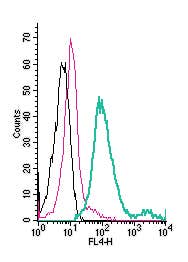 A Rabbit Polyclonal Antibody to MCT1 (extracellular) conjugated to the fluorescent dye Allophycocyanin (APC)
- Product Code: AMT-011-APC
- Short Description: A Rabbit Polyclonal Antibody to MCT1 (extracellular) conjugated to the fluorescent dye Allophycocyanin (APC)
- Host: Rabbit
- Label: APC
- Reactivity: Human, Rat, Mouse
- Applications: Live cell imaging, Flow cytometry
- Target: Monocarboxylate transporter 1, Monocarboxylic acid transporter 1
-

 A Rabbit Polyclonal Antibody to Monocarboxylate Transporter 1
- Product Code: AMT-011
- Short Description: A Rabbit Polyclonal Antibody to Monocarboxylate Transporter 1
- Host: Rabbit
- Label: Unconjugated
- Reactivity: Human, Rat, Mouse
- Applications: Indirect flow cytometry, Live cell imaging, Western blot, Immunofluorescence, Immunohistochemistry
- Target: Monocarboxylate transporter 1, Monocarboxylic acid transporter 1
-
 A Rabbit Polyclonal Antibody to Vesicular Monoamine Transporter 1
- Product Code: AMT-007
- Short Description: A Rabbit Polyclonal Antibody to Vesicular Monoamine Transporter 1
- Host: Rabbit
- Label: Unconjugated
- Reactivity: Rat, Mouse
- Applications: Western blot
- Target: Vesicular monoamine transporter 1, SLC18A1, CGAT, VAT1
-
 A Rabbit Polyclonal Antibody to Vesicular Monoamine Transporter 2 Conjugated to the Fluorescent Dye ATTO-488
- Product Code: AMT-006-AG
- Short Description: A Rabbit Polyclonal Antibody to Vesicular Monoamine Transporter 2 Conjugated to the Fluorescent Dye ATTO-488
- Host: Rabbit
- Label: ATTO 488
- Reactivity: Human, Rat, Mouse
- Applications: Immunofluorescence, Immunohistochemistry
- Target: Vesicular monoamine transporter 2, SLC18A2, SVAT, VAT2
Loading...