-
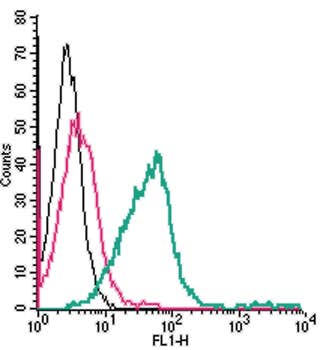 A Rabbit Polyclonal Antibody to TRPM2 Channel conjugated to the fluorescent dye FITC
- Product Code: ACC-128-F
- Short Description: A Rabbit Polyclonal Antibody to TRPM2 Channel conjugated to the fluorescent dye FITC
- Host: Rabbit
- Label: FITC
- Reactivity: Human, Rat, Mouse
- Applications: Live cell imaging, Flow cytometry
- Target: Transient receptor potential cation channel subfamily M member 2, Transient receptor potential melastatin 2, LTrpC2, TrpC7
-

 A Rabbit Polyclonal Antibody to TRPM2 Channel
- Product Code: ACC-043
- Short Description: A Rabbit Polyclonal Antibody to TRPM2 Channel
- Host: Rabbit
- Label: Unconjugated
- Reactivity: Human, Rat, Mouse
- Applications: Western blot, Immunocytochemistry, Immunofluorescence, Immunohistochemistry
- Target: Transient receptor potential cation channel subfamily M member 2, LTrpC2, TrpC7
-
 A Rabbit Polyclonal Antibody to TRPM2 Channel Conjugated to the Fluorescent Dye ATTO-594
- Product Code: ACC-043-AR
- Short Description: A Rabbit Polyclonal Antibody to TRPM2 Channel Conjugated to the Fluorescent Dye ATTO-594
- Host: Rabbit
- Label: ATTO 594
- Reactivity: Human, Rat, Mouse
- Applications: Immunocytochemistry, Immunofluorescence, Immunohistochemistry
- Target: Transient receptor potential cation channel subfamily M member 2, LTrpC2, TrpC7
-
 A Rabbit Polyclonal Antibody to TRPML1 (Mucolipin 1) Channel
- Product Code: ACC-081
- Short Description: A Rabbit Polyclonal Antibody to TRPML1 (Mucolipin 1) Channel
- Host: Rabbit
- Label: Unconjugated
- Reactivity: Human, Rat, Mouse
- Applications: Western blot, Immunohistochemistry
- Target: Mcoln1, Mucolipidin
-
 A Rabbit Polyclonal Antibody to TRPML2 (Mucolipin-2) Channel
- Product Code: ACC-082
- Short Description: A Rabbit Polyclonal Antibody to TRPML2 (Mucolipin-2) Channel
- Host: Rabbit
- Label: Unconjugated
- Reactivity: Human, Rat, Mouse
- Applications: Western blot, Immunocytochemistry, Immunofluorescence, Immunohistochemistry
- Target: Mcoln2
-
 A Rabbit Polyclonal Antibody to TRPML3 (Mucolipin 3) Channel
- Product Code: ACC-083
- Short Description: A Rabbit Polyclonal Antibody to TRPML3 (Mucolipin 3) Channel
- Host: Rabbit
- Label: Unconjugated
- Reactivity: Human, Rat, Mouse
- Applications: Western blot, Immunocytochemistry, Immunofluorescence, Immunohistochemistry
- Target: Mcoln3
-
 A Rabbit Polyclonal Antibody to TRPML3 Channel Conjugated to the Fluorescent Dye ATTO-594
- Product Code: ACC-083-AR
- Short Description: A Rabbit Polyclonal Antibody to TRPML3 Channel Conjugated to the Fluorescent Dye ATTO-594
- Host: Rabbit
- Label: ATTO 594
- Reactivity: Human, Rat, Mouse
- Applications: Immunofluorescence, Immunohistochemistry
- Target: Mcoln3
-
 A Rabbit Polyclonal Antibody to VAMP-2
- Product Code: ANR-007
- Short Description: A Rabbit Polyclonal Antibody to VAMP-2
- Host: Rabbit
- Label: Unconjugated
- Reactivity: Rat, Mouse
- Applications: Western blot, Immunofluorescence, Immunohistochemistry
- Target: Vesicle-associated membrane protein 2, Synaptobrevin 2, Syb2
-
 A Rabbit Polyclonal Antibody to Vesicular Acetylcholine Transporter
- Product Code: ACT-003
- Short Description: A Rabbit Polyclonal Antibody to Vesicular Acetylcholine Transporter
- Host: Rabbit
- Label: Unconjugated
- Reactivity: Rat, Mouse
- Applications: Western blot, Immunofluorescence, Immunohistochemistry
- Target: Solute carrier family 18 member 3, SLC18A3
-
 A Rabbit Polyclonal Antibody to Vesicular GABA Transporter
- Product Code: AGT-005
- Short Description: A Rabbit Polyclonal Antibody to Vesicular GABA Transporter
- Host: Rabbit
- Label: Unconjugated
- Reactivity: Human, Rat, Mouse
- Applications: Western blot, Immunocytochemistry, Immunofluorescence, Immunohistochemistry
- Target: Vesicular inhibitory amino acid transporter, VIAAT, GABA and glycine transporter, SLC32A1
Loading...