-
 A Guinea Pig Polyclonal Antibody to PSD-95
- Product Code: APZ-009-GP
- Short Description: A Guinea Pig Polyclonal Antibody to PSD-95
- Host: Guinea Pig
- Label: Unconjugated
- Reactivity: Human, Rat, Mouse
- Applications: Western blot
- Target: Postsynaptic density protein 95, Discs large homolog 4, DLG4, Synapse-associated protein 90, SAP-90, Tax interaction protein 15, MRD62
-
 A Guinea Pig Polyclonal Antibody to SCN2A (NaV1.2) Channel
- Product Code: ASC-002-GP
- Short Description: A Guinea Pig Polyclonal Antibody to SCN2A (NaV1.2) Channel
- Host: Guinea Pig
- Label: Unconjugated
- Reactivity: Human, Rat, Mouse
- Applications: Western blot, Immunofluorescence, Immunohistochemistry
- Target: BII, Brain type II Na+ channel, Sodium channel protein type 2 subunit alpha
-
 A Guinea Pig Polyclonal Antibody to Synaptophysin
- Product Code: ANR-013-GP
- Short Description: A Guinea Pig Polyclonal Antibody to Synaptophysin
- Host: Guinea Pig
- Label: Unconjugated
- Reactivity: Human, Rat, Mouse
- Applications: Western blot, Immunohistochemistry
- Target: Major synaptic vesicle protein p38, SYP
-
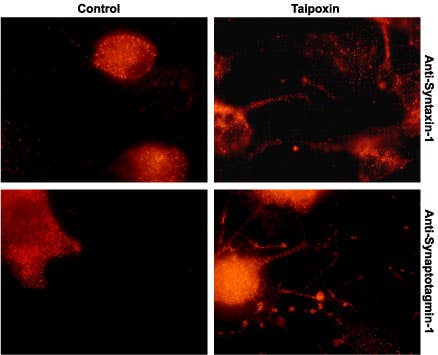
 A Guinea Pig Polyclonal Antibody to Anti-Synaptotagmin-1 (SYT1)
- Product Code: ANR-003-GP
- Short Description: A Guinea Pig Polyclonal Antibody to Anti-Synaptotagmin-1 (SYT1)
- Host: Guinea Pig
- Label: Unconjugated
- Reactivity: Rat, Mouse
- Applications: Western blot, Immunohistochemistry
- Target: Synaptotagmin I, SytI, p65, SVP65
-
 A Guinea Pig Polyclonal Antibody to TrkB
- Product Code: ANT-019-GP
- Short Description: A Guinea Pig Polyclonal Antibody to TrkB
- Host: Guinea Pig
- Label: Unconjugated
- Reactivity: Human, Rat, Mouse
- Applications: Western blot, Immunohistochemistry
- Target: Neurotrophic tyrosine kinase receptor type 2, NTRK2, BDNF/NT-3 growth factors receptor, TrkB Tyrosine Kinase
-
 A Guinea Pig Polyclonal Antibody to Vesicular GABA Transporter
- Product Code: AGT-005-GP
- Short Description: A Guinea Pig Polyclonal Antibody to Vesicular GABA Transporter
- Host: Guinea Pig
- Label: Unconjugated
- Reactivity: Human, Rat, Mouse
- Applications: Western blot, Immunohistochemistry
- Target: Vesicular inhibitory amino acid transporter, VIAAT, GABA and glycine transporter, rGVAT, SLC32A1
-
 A Guinea Pig Polyclonal Antibody to VGLUT1
- Product Code: AGC-035-GP
- Short Description: A Guinea Pig Polyclonal Antibody to VGLUT1
- Host: Guinea Pig
- Label: Unconjugated
- Reactivity: Human, Rat, Mouse
- Applications: Western blot, Immunohistochemistry
- Target: Vesicular glutamate transporter 1, Brain-specific Na+-dependent inorganic phosphate cotransporter, BNPI, SLC17A7
-
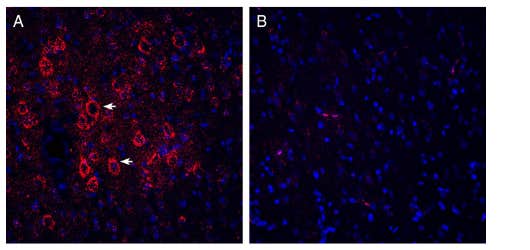 A Guinea Pig Polyclonal Antibody to Vesicular Glutamate Transporter 2
- Product Code: AGC-036-GP
- Short Description: A Guinea Pig Polyclonal Antibody to Vesicular Glutamate Transporter 2
- Host: Guinea Pig
- Label: Unconjugated
- Reactivity: Human, Rat, Mouse
- Applications: Western blot, Immunohistochemistry
- Target: Vesicular glutamate transporter 2, Differentiation-associated Na+-dependent inorganic phosphate cotransporter, DNPI, SLC17A6
-

 An Activator of CaV2.2 and CaV2.1 Ca2+ Channels
- Product Code: G-140
- Short Description: An Activator of CaV2.2 and CaV2.1 Ca2+ Channels
- CAS No.: 1402821-41-3
- MW: 374.2
-
 A Negative Allosteric Modulator of Human P2X7 Receptors
- Product Code: G-115
- Short Description: A Negative Allosteric Modulator of Human P2X7 Receptors
- CAS No.: 309712-55-8
- MW: 483.81
Loading...