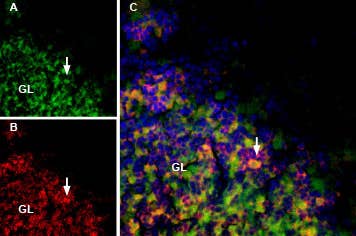
-

 A Rabbit Polyclonal Antibody to ASIC2a Channel Conjugated to the Fluorescent Dye ATTO-594
- Product Code: ASC-012-AR
- Short Description: A Rabbit Polyclonal Antibody to ASIC2a Channel Conjugated to the Fluorescent Dye ATTO-594
- Host: Rabbit
- Label: ATTO 594
- Reactivity: Human, Rat, Mouse
- Applications: Immunofluorescence, Immunohistochemistry
- Target: ACCN1, Acid-sensing ion channel 2, Brain sodium channel 1, BNaC1, BNC1, Amiloride-sensitive cation channel neuronal 1, Mammalian degenerin homolog, MDEG
-
 A Rabbit Polyclonal Antibody to ASIC3 Channel
- Product Code: ASC-018
- Short Description: A Rabbit Polyclonal Antibody to ASIC3 Channel
- Host: Rabbit
- Label: Unconjugated
- Reactivity: Human, Rat, Mouse
- Applications: Western blot, Immunocytochemistry, Immunofluorescence, Immunohistochemistry
- Target: Acid-sensing ion channel 3, Amiloride-sensitive cation channel 3, ACCN3, DRASIC
-
 A Rabbit Polyclonal Antibody to ASIC5 Channel
- Product Code: ASC-032
- Short Description: A Rabbit Polyclonal Antibody to ASIC5 Channel
- Host: Rabbit
- Label: Unconjugated
- Reactivity: Rat, Mouse
- Applications: Western blot, Immunofluorescence, Immunohistochemistry
- Target: Acid-sensing ion channel 5, Amiloride-sensitive cation channel 5, Brain-liver-intestine amiloride-sensitive Na+ channel, BLINaC, HINAC, ACCN5
-
 A Rabbit Polyclonal Antibody to BDNF
- Product Code: ANT-010
- Short Description: A Rabbit Polyclonal Antibody to BDNF
- Host: Rabbit
- Label: Unconjugated
- Reactivity: Human, Rat, Mouse
- Applications: Western blot, Immunocytochemistry, Immunofluorescence, Immunohistochemistry
- Target: Brain-derived neurotrophic factor
-
 A Rabbit Polyclonal Antibody to Bestrophin-1 Channel
- Product Code: ABC-001
- Short Description: A Rabbit Polyclonal Antibody to Bestrophin-1 Channel
- Host: Rabbit
- Label: Unconjugated
- Reactivity: Human, Rat, Mouse
- Applications: Indirect flow cytometry, Live cell imaging, Western blot, Immunohistochemistry
- Target: BEST1, Vitelliform macular dystrophy protein 2, VMD2, BMD1
-
 A Rabbit Polyclonal Antibody to Bestrophin-2 Channel
- Product Code: ABC-002
- Short Description: A Rabbit Polyclonal Antibody to Bestrophin-2 Channel
- Host: Rabbit
- Label: Unconjugated
- Reactivity: Human, Rat, Mouse
- Applications: Western blot, Immunohistochemistry
- Target: BEST2, Vitelliform macular dystrophy 2-like protein 1, VMD2L1
-
 A Rabbit Polyclonal Antibody to Bombesin Receptor 1/Neuromedin B Receptor
- Product Code: ABR-004
- Short Description: A Rabbit Polyclonal Antibody to Bombesin Receptor 1/Neuromedin B Receptor
- Host: Rabbit
- Label: Unconjugated
- Reactivity: Human, Rat, Mouse
- Applications: Western blot, Immunocytochemistry, Immunofluorescence, Immunohistochemistry
- Target: BB1R, Neuromedin B receptor, Neuromedin-B-preferring bombesin receptor
-
 A Rabbit Polyclonal Antibody to Bombesin Receptor 2/Gastrin-releasing Peptide Receptor
- Product Code: ABR-002
- Short Description: A Rabbit Polyclonal Antibody to Bombesin Receptor 2/Gastrin-releasing Peptide Receptor
- Host: Rabbit
- Label: Unconjugated
- Reactivity: Human, Rat, Mouse
- Applications: Live cell imaging, Western blot, Immunocytochemistry, Immunofluorescence, Immunohistochemistry
- Target: BB2R, Gastrin-releasing peptide receptor, GRP-preferring bombesin receptor
-
 A Rabbit Polyclonal Antibody to CACNA1A (CaV2.1) Channel
- Product Code: ACC-001
- Short Description: A Rabbit Polyclonal Antibody to CACNA1A (CaV2.1) Channel
- Host: Rabbit
- Label: Unconjugated
- Reactivity: Human, Rat, Mouse
- Applications: Western blot, Immunocytochemistry, Immunofluorescence, Immunohistochemistry
- Target: Voltage-dependent P/Q-type calcium channel subunit α1A, Brain calcium channel I, BI
-
 A Rabbit Polyclonal Antibody to CACNA1B (CaV2.2) Channel
- Product Code: ACC-002
- Short Description: A Rabbit Polyclonal Antibody to CACNA1B (CaV2.2) Channel
- Host: Rabbit
- Label: Unconjugated
- Reactivity: Human, Rat, Mouse
- Applications: Western blot, Immunocytochemistry, Immunofluorescence, Immunoprecipitation, Immunohistochemistry
- Target: Voltage-dependent N-type calcium channel subunit α1B, Brain calcium channel III, BIII
Loading...