-
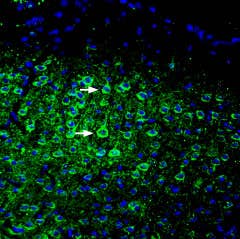
 A Rabbit Polyclonal Antibody to KCNK9 Channel
- Product Code: APC-044
- Short Description: A Rabbit Polyclonal Antibody to KCNK9 Channel
- Host: Rabbit
- Label: Unconjugated
- Reactivity: Human, Mouse
- Applications: Western blot, Immunofluorescence, Immunohistochemistry
- Target: Potassium channel subfamily K member 9, K2P9.1, TWIK-related acid-sensitive K+ channel 3, Two pore K+ channel KT3.2
-
 A Rabbit Polyclonal Antibody to KCNN1 (KCa2.1, SK1) Channel
- Product Code: APC-039
- Short Description: A Rabbit Polyclonal Antibody to KCNN1 (KCa2.1, SK1) Channel
- Host: Rabbit
- Label: Unconjugated
- Reactivity: Rat, Mouse
- Applications: Western blot, Immunocytochemistry, Immunofluorescence, Immunohistochemistry
- Target: SKCa1, Small conductance calcium-activated potassium channel protein 1
-
 A Rabbit Polyclonal Antibody to KCNN2 (KCa2.2, SK2) Channel
- Product Code: APC-028
- Short Description: A Rabbit Polyclonal Antibody to KCNN2 (KCa2.2, SK2) Channel
- Host: Rabbit
- Label: Unconjugated
- Reactivity: Human, Rat, Mouse
- Applications: Western blot, Immunocytochemistry, Immunofluorescence, Immunoprecipitation, Immunohistochemistry
- Target: SKCa2, Small conductance calcium-activated potassium channel protein 2, Apamin-sensitive small conductance Ca2+-dependent K+ channel
-
 A Rabbit Polyclonal Antibody to KCNQ2 (KV7.2) Channel
- Product Code: APC-050
- Short Description: A Rabbit Polyclonal Antibody to KCNQ2 (KV7.2) Channel
- Host: Rabbit
- Label: Unconjugated
- Reactivity: Human, Rat, Mouse
- Applications: Western blot, Immunocytochemistry, Immunofluorescence, Immunohistochemistry
- Target: KV7.2, Voltage-gated potassium channel QKT subfamily member 2, KvLQT2
-

 A Rabbit Polyclonal Antibody to KCNQ3 (KV7.3) Channel
- Product Code: APC-051
- Short Description: A Rabbit Polyclonal Antibody to KCNQ3 (KV7.3) Channel
- Host: Rabbit
- Label: Unconjugated
- Reactivity: Rat, Mouse
- Applications: Western blot, Immunocytochemistry, Immunofluorescence, Immunoprecipitation, Immunohistochemistry
- Target: KV7.3, Potassium voltage-gated channel subfamily KQT member 3, BFNC2
-
 A Rabbit Polyclonal Antibody to KCNS1 (KV9.1) Channel
- Product Code: APC-131
- Short Description: A Rabbit Polyclonal Antibody to KCNS1 (KV9.1) Channel
- Host: Rabbit
- Label: Unconjugated
- Reactivity: Human, Rat, Mouse
- Applications: Western blot
- Target: Potassium voltage-gated channel subfamily S member 1
-
 A Rabbit Polyclonal Antibody to KV9.2 Channel
- Product Code: APC-132
- Short Description: A Rabbit Polyclonal Antibody to KV9.2 Channel
- Host: Rabbit
- Label: Unconjugated
- Reactivity: Human, Rat, Mouse
- Applications: Western blot
- Target: Voltage-gated K+ channel subunit KV9.2
-
 A Rabbit Polyclonal Antibody to KCNS3 (KV9.3) Channel
- Product Code: APC-133
- Short Description: A Rabbit Polyclonal Antibody to KCNS3 (KV9.3) Channel
- Host: Rabbit
- Label: Unconjugated
- Reactivity: Human, Rat, Mouse
- Applications: Western blot, Immunofluorescence, Immunohistochemistry
- Target: Potassium voltage-gated channel subfamily S member 3
-
 A Rabbit Polyclonal Antibody to KCNT1 (Slack)
- Product Code: APC-124
- Short Description: A Rabbit Polyclonal Antibody to KCNT1 (Slack)
- Host: Rabbit
- Label: Unconjugated
- Reactivity: Rat, Mouse
- Applications: Western blot, Immunohistochemistry
- Target: KCa4.1, KNa1.1, Slo2.2 Na+-activated K+ channel, Potassium channel subfamily T member 1
-
 A Rabbit Polyclonal Antibody to KCNT2 (Slick)
- Product Code: APC-126
- Short Description: A Rabbit Polyclonal Antibody to KCNT2 (Slick)
- Host: Rabbit
- Label: Unconjugated
- Reactivity: Rat, Mouse
- Applications: Western blot, Immunocytochemistry, Immunofluorescence
- Target: KCa4.2, Slo2.1 Na+ and Cl--activated K+ channel, Potassium channel subfamily T member 2
Loading...