-

 A recombinant human cytokine that promotes cardiac myocyte hypertrophy and survival, and acts as a neurotrophic factor via the gp130/LIFR receptor complex
- Product Code: C-200
- Short Description: A recombinant human cytokine that promotes cardiac myocyte hypertrophy and survival, and acts as a neurotrophic factor via the gp130/LIFR receptor complex
- Applications: Cell Culture, Western blot
- MW: 21.1 kDa
-
 A potent survival factor for neurons and oligodendrocytes
- Product Code: C-240
- Short Description: A potent survival factor for neurons and oligodendrocytes
- Applications: Cell Culture, Western blot
- MW: 22.9 kDa
-
 A recombinant human EGF that stimulates cell proliferation and survival via EGFR binding
- Product Code: E-100
- Short Description: A recombinant human EGF that stimulates cell proliferation and survival via EGFR binding
- Applications: Cell Culture, Western blot
- MW: 6.2 kDa
-
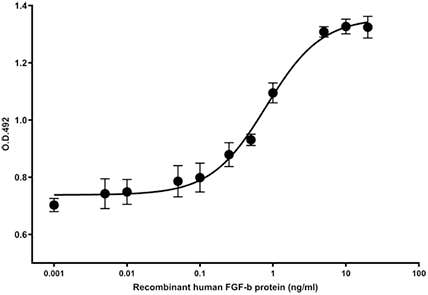 A recombinant human growth factor (FGF-2/bFGF) that promotes cell proliferation, angiogenesis, and neuronal survival via FGFR receptors
- Product Code: F-170
- Short Description: A recombinant human growth factor (FGF-2/bFGF) that promotes cell proliferation, angiogenesis, and neuronal survival via FGFR receptors
- Applications: Cell Culture, Neurosphere formation, Proliferation assay
- MW: 16.5 kDa
-
 A recombinant human Leukemia Inhibitory Factor (LIF) cytokine that promotes stem cell self-renewal and inhibits differentiation by signaling through the LIFR/gp130 receptor complex
- Product Code: L-200
- Short Description: A recombinant human Leukemia Inhibitory Factor (LIF) cytokine that promotes stem cell self-renewal and inhibits differentiation by signaling through the LIFR/gp130 receptor complex
- Applications: Cell Culture, Proliferation assay, Western blot
- MW: 19.7 kDa
-
 A recombinant human neurotrophin that promotes neuronal survival and differentiation via the TrkC and p75NTR receptors
- Product Code: N-260
- Short Description: A recombinant human neurotrophin that promotes neuronal survival and differentiation via the TrkC and p75NTR receptors
- Applications: Cell Culture, In vivo, Western blot, Neurite outgrowth assay
- MW: 27.2 kDa (dimer)
-
 A recombinant human neurotrophin that promotes neuronal survival and differentiation via the TrkB and p75NTR receptors
- Product Code: N-270
- Short Description: A recombinant human neurotrophin that promotes neuronal survival and differentiation via the TrkB and p75NTR receptors
- Applications: Cell Culture, Survival assay, Western blot
- MW: 28.1 kDa
-
 A recombinant human heparin-binding growth factor (PTN) that promotes neuronal growth, angiogenesis, and cell proliferation by binding to receptors including PTPRZ and ALK
- Product Code: P-150
- Short Description: A recombinant human heparin-binding growth factor (PTN) that promotes neuronal growth, angiogenesis, and cell proliferation by binding to receptors including PTPRZ and ALK
- Applications: Neurite outgrowth assay
- MW: 15.4 kDa
-
 A recombinant human, cleavage-resistant proBDNF protein produced in E. coli that functions exclusively as a ligand for the p75NTR/sortilin receptor complex
- Product Code: B-256
- Short Description: A recombinant human, cleavage-resistant proBDNF protein produced in E. coli that functions exclusively as a ligand for the p75NTR/sortilin receptor complex
- Applications: Cell Culture, Western blot
- MW: 51.41 kDa (dimer)
-
 A recombinant human proBDNF protein produced in E. coli that functions exclusively as a ligand for the p75NTR/sortilin receptor complex
- Product Code: B-257
- Short Description: A recombinant human proBDNF protein produced in E. coli that functions exclusively as a ligand for the p75NTR/sortilin receptor complex
- Applications: Cell Culture, In vitro binding assay, Western blot
- MW: 51.78 kDa (dimer)
Loading...