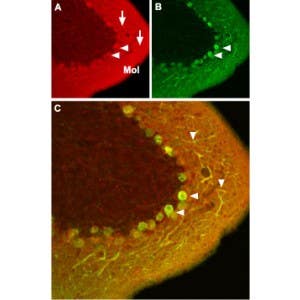
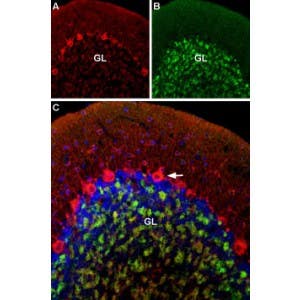
-
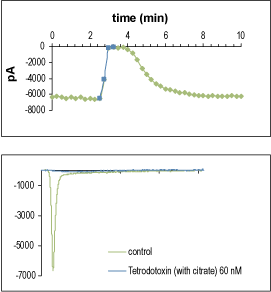
 Tetrodotoxin citrate (#T-550) is a highly pure, natural, and biologically active compound.
- Product Code: T-550
- Applications: Electrophysiology
- CAS No.: 18660-81-6
- MW: 319.27
-
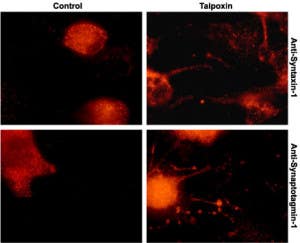 A blocker of synaptic vesicle recycling
- Product Code: T-460
- Short Description: A blocker of synaptic vesicle recycling
- Applications: Neurite outgrowth assay, Immunocytochemistry
- CAS No.: 52019-39-3
- MW: 46 kDa
-
 A Rabbit Polyclonal Antibody to KV1.3 (KCNA3) Channel Conjugated to the Fluorescent Dye Phycoerythrin
- Product Code: APC-101-PE
- Short Description: A Rabbit Polyclonal Antibody to KV1.3 (KCNA3) Channel Conjugated to the Fluorescent Dye Phycoerythrin
- Host: Rabbit
- Reactivity: Human, Rat, Mouse
- Applications: Live cell imaging, Flow cytometry
- Target: Potassium voltage-gated channel subfamily A member 3
-
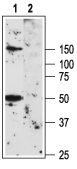
 A Rabbit Polyclonal Antibody to KV1.3 (KCNA3) Channel
- Product Code: APC-101
- Short Description: A Rabbit Polyclonal Antibody to KV1.3 (KCNA3) Channel
- Host: Rabbit
- Reactivity: Human, Rat, Mouse
- Applications: Indirect flow cytometry, Live cell imaging, Western blot, Immunocytochemistry, Immunofluorescence, Immunoprecipitation, Immunohistochemistry
- Target: Potassium voltage-gated channel subfamily A member 3
-
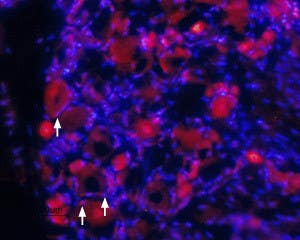 A Rabbit Polyclonal Antibody to TrkA
- Product Code: ANT-018
- Short Description: A Rabbit Polyclonal Antibody to TrkA
- Host: Rabbit
- Reactivity: Human, Rat, Mouse
- Applications: Indirect flow cytometry, Live cell imaging, Western blot, Immunocytochemistry, Immunofluorescence, Immunohistochemistry
-
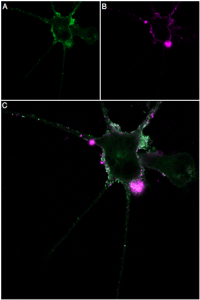 A fluorescent probe for imaging and sensitive detection of KCa1.1 (BK) K+ channels
- Product Code: STI-400-FRN
- Short Description: A fluorescent probe for imaging and sensitive detection of KCa1.1 (BK) K+ channels
- Applications: Electrophysiology, Direct flow cytometry, Fluorescence staining, Live cell imaging, Immunofluorescence
- MW: 4858 Da
-
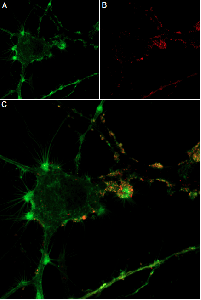 A fluorescent probe for imaging and sensitive detection of Kir1.1 and GIRK potassium channels
- Product Code: STT-170-FR
- Short Description: A fluorescent probe for imaging and sensitive detection of Kir1.1 and GIRK potassium channels
- Applications: Electrophysiology, Fluorescence staining, Live cell imaging, Immunofluorescence
- MW: 3159.6 Da
-
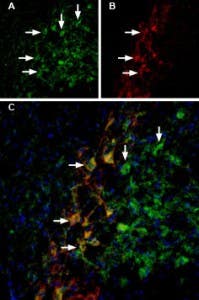 A fluorescent probe for imaging and sensitive detection of Kir1.1 and GIRK potassium channels
- Product Code: STT-170-AG
- Short Description: A fluorescent probe for imaging and sensitive detection of Kir1.1 and GIRK potassium channels
- Applications: Electrophysiology, Direct flow cytometry, Live cell imaging, Immunofluorescence
- MW: 3195.5 Da
-
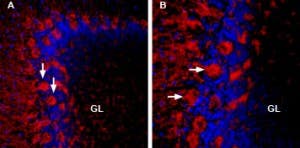 A biotinylated probe for imaging and sensitive detection of multiple KV1 channels (KV1.1, KV1.3, KV1.4, KV1.6) and KCa3.1 channels.
- Product Code: STS-400-B
- Applications: Electrophysiology, Immunofluorescence, Indirect flow cytometry
- MW: 4563 Da
-
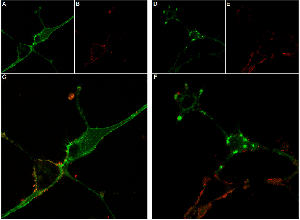 A fluorescent probe for imaging and sensitive detection of multiple KV1 channels (KV1.1, KV1.3, KV1.4, KV1.6) and KCa3.1 channels.
- Product Code: STS-400-AR
- Applications: Electrophysiology, Direct flow cytometry, Live cell imaging, Immunofluorescence
- MW: ~4627 Da
Loading...