-
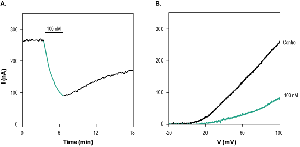
 A potent and specific blocker of KCa1.1 K+ channels
- Product Code: STI-400
- Short Description: A potent and specific blocker of KCa1.1 K+ channels
- Applications: Electrophysiology
- CAS No.: 129203-60-7
- MW: 4230.8 Da
-
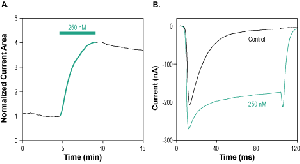 A potent and selective activator of NaV1.1 channels
- Product Code: STH-601
- Short Description: A potent and selective activator of NaV1.1 channels
- Applications: Electrophysiology
- MW: 3996.4 Da
-
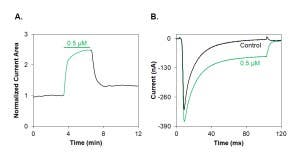 A potent activator of multiple sodium channels (NaV1.1-NaV1.7)
- Product Code: STH-555
- Short Description: A potent activator of multiple sodium channels (NaV1.1-NaV1.7)
- Applications: Electrophysiology
- MW: 7118 Da
-
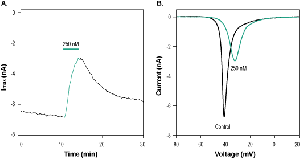 A potent gating modifier of tetrodotoxin-sensitive (TTX-s) neuronal voltage-gated sodium (NaV) channels that also blocks hERG1 potassium channels
- Product Code: STG-250
- Short Description: A potent gating modifier of tetrodotoxin-sensitive (TTX-s) neuronal voltage-gated sodium (NaV) channels that also blocks hERG1 potassium channels
- Applications: Electrophysiology
- MW: 3697.5 Da
-
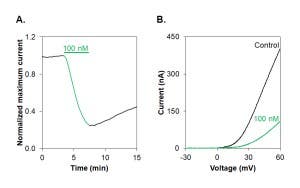 A potent gating modifier of KV2.1 and KV2.2 K+ channels that also inhibits KV4.3 channels
- Product Code: STG-200
- Short Description: A potent gating modifier of KV2.1 and KV2.2 K+ channels that also inhibits KV4.3 channels
- Applications: Electrophysiology
- CAS No.: 1233152-82-3
- MW: 3948.7 Da
-
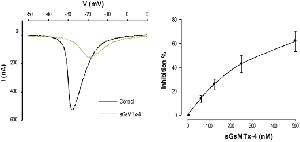 A potent inhibitor of mechanosensitive ion channels (Piezo1, TRPC1, TRPC6) and NaV1.7 sodium channels
- Product Code: STG-100
- Applications: Electrophysiology
- CAS No.: 1209500-46-8
- MW: 4096 Da
-
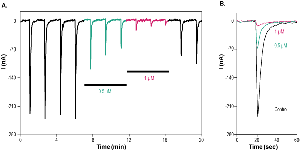 A potent and selective antagonist of the muscle-type nicotinic acetylcholine receptor (nAChR)
- Product Code: STC-900
- Short Description: A potent and selective antagonist of the muscle-type nicotinic acetylcholine receptor (nAChR)
- Applications: Electrophysiology
- CAS No.: 170663-33-9
- MW: 2093.4 Da
-
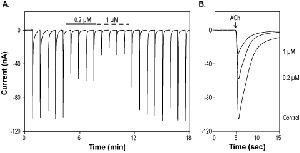 A potent and selective antagonist of the muscle-type nicotinic acetylcholine receptors (nAChRs)
- Product Code: STC-825
- Short Description: A potent and selective antagonist of the muscle-type nicotinic acetylcholine receptors (nAChRs)
- Applications: Electrophysiology
- CAS No.: 115797-06-3
- MW: 1353.6 Da
-
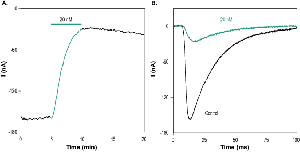 A potent and selective blocker of skeletal muscle NaV1.4 voltage-gated sodium channels
- Product Code: STC-690
- Short Description: A potent and selective blocker of skeletal muscle NaV1.4 voltage-gated sodium channels
- Applications: Electrophysiology
- MW: 3006 Da
-
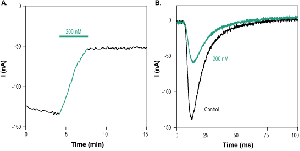 A potent blocker of neuronal NaV1.2 voltage-gated sodium channels that also inhibits NaV1.1, NaV1.4, NaV1.5 and NaV1.7 channels
- Product Code: STC-680
- Applications: Electrophysiology
- MW: 4044.6 Da
Loading...