-
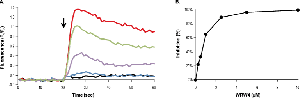
 A Potent Antagonist of FPR2 and FPR3 G-Protein Coupled Receptors
- Product Code: GPW-110
- Short Description: A Potent Antagonist of FPR2 and FPR3 G-Protein Coupled Receptors
- Applications: Calcium imaging assay
- CAS No.: 878557-55-2
- MW: 1104.3 Da
-
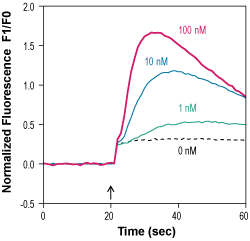 A Potent Agonist of FPR2 and FPR3 G-Protein Coupled Receptors
- Product Code: GPW-105
- Short Description: A Potent Agonist of FPR2 and FPR3 G-Protein Coupled Receptors
- Applications: Calcium imaging assay
- CAS No.: 187986-17-0
- MW: 856.11 Da
-
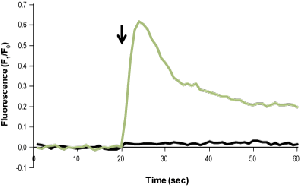 A Potent Agonist of FPR2 and FPR3 G-Protein Coupled Receptors
- Product Code: GPW-100
- Short Description: A Potent Agonist of FPR2 and FPR3 G-Protein Coupled Receptors
- Applications: Calcium imaging assay
- CAS No.: 187986-11-4
- MW: 856.11 Da
-
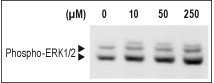 A Potent Agonist of PAR2, Derived from PAR2 Auto-Ligand Sequence
- Product Code: GPS-100
- Applications: Aequorin functional assay, Western blot, Calcium imaging assay
- CAS No.: 190383-13-2
- MW: 614.77 Da
-
 A Potent and Selective Agonist of FPR2 G-Protein Coupled Receptors
- Product Code: GPM-120
- Short Description: A Potent and Selective Agonist of FPR2 G-Protein Coupled Receptors
- Applications: Calcium imaging assay
- CAS No.: 271246-66-3
- MW: 1611 Da
-
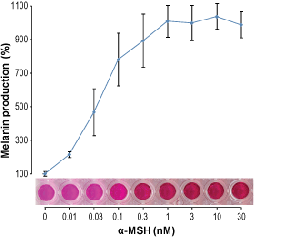 A Ligand of Melanocortin G-Protein Coupled Receptor
- Product Code: GPM-100
- Short Description: A Ligand of Melanocortin G-Protein Coupled Receptor
- Applications: Melanin production assay
- CAS No.: 581-05-5
- MW: 1665 Da
-
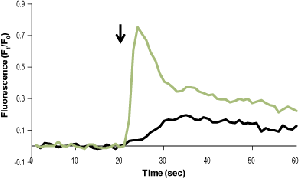 A Potent Agonist of FPR1 G-Protein Coupled Receptor
- Product Code: GPF-100
- Short Description: A Potent Agonist of FPR1 G-Protein Coupled Receptor
- Applications: Calcium imaging assay
- CAS No.: 59880-97-6
- MW: 437.6 Da
-
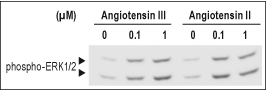 A Ligand of AT1 and AT2 G-Protein Coupled Receptors
- Product Code: GPA-130
- Short Description: A Ligand of AT1 and AT2 G-Protein Coupled Receptors
- Applications: Aequorin functional assay, Western blot, Calcium imaging assay
- CAS No.: 13602-53-4
- MW: 931.1 Da
-
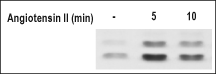 A Ligand of AT1 and AT2 G-Protein Coupled Receptors
- Product Code: GPA-100
- Short Description: A Ligand of AT1 and AT2 G-Protein Coupled Receptors
- Applications: Aequorin functional assay, Western blot, Calcium imaging assay
- CAS No.: 4474-91-3
- MW: 1046.2 Da
-
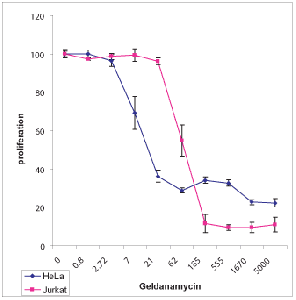 A Powerful Anticancer Antibiotic
- Product Code: G-500
- Short Description: A Powerful Anticancer Antibiotic
- CAS No.: 30562-34-6
- MW: 560.6
Loading...