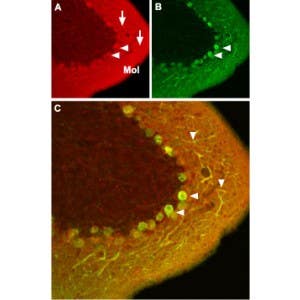
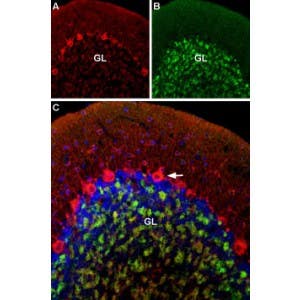
-
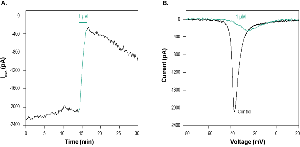
 A potent gating modifier of tetrodotoxin-sensitive (TTX-s) neuronal voltage-gated sodium (NaV) channels that also blocks hERG1 potassium channels
- Product Code: STG-350
- Short Description: A potent gating modifier of tetrodotoxin-sensitive (TTX-s) neuronal voltage-gated sodium (NaV) channels that also blocks hERG1 potassium channels
- Applications: Electrophysiology
- MW: 3979.8 Da
-
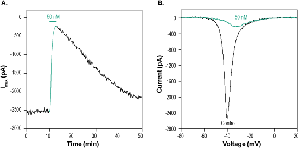 A potent gating modifier of tetrodotoxin-sensitive (TTX-s) neuronal voltage-gated sodium (NaV) channels that also blocks hERG1 potassium channels
- Product Code: STG-300
- Short Description: A potent gating modifier of tetrodotoxin-sensitive (TTX-s) neuronal voltage-gated sodium (NaV) channels that also blocks hERG1 potassium channels
- Applications: Electrophysiology
- MW: 3707.5 Da
-
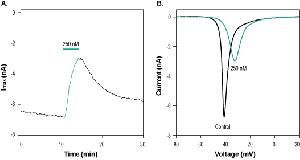 A potent gating modifier of tetrodotoxin-sensitive (TTX-s) neuronal voltage-gated sodium (NaV) channels that also blocks hERG1 potassium channels
- Product Code: STG-250
- Short Description: A potent gating modifier of tetrodotoxin-sensitive (TTX-s) neuronal voltage-gated sodium (NaV) channels that also blocks hERG1 potassium channels
- Applications: Electrophysiology
- MW: 3697.5 Da
-
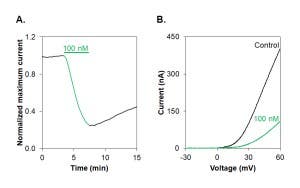 A potent gating modifier of KV2.1 and KV2.2 K+ channels that also inhibits KV4.3 channels
- Product Code: STG-200
- Short Description: A potent gating modifier of KV2.1 and KV2.2 K+ channels that also inhibits KV4.3 channels
- Applications: Electrophysiology
- CAS No.: 1233152-82-3
- MW: 3948.7 Da
-
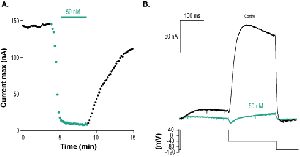 A potent and selective blocker of hERG (KV11.1) potassium channels
- Product Code: STE-450
- Short Description: A potent and selective blocker of hERG (KV11.1) potassium channels
- Applications: Electrophysiology
- CAS No.: 8006-25-5
- MW: 4730 Da
-
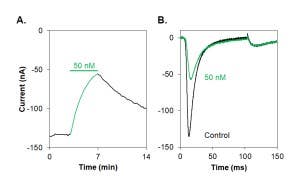 A broad-spectrum modulator of voltage-gated sodium (NaV) channels that also inhibits T-type (CaV3) calcium channels
- Product Code: STD-050
- Short Description: A broad-spectrum modulator of voltage-gated sodium (NaV) channels that also inhibits T-type (CaV3) calcium channels
- Applications: Electrophysiology
- MW: 4078.6 Da
-
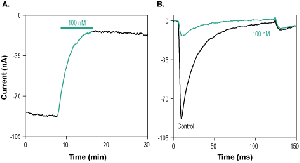 A potent blocker of neuronal NaV1.2 and skeletal muscle NaV1.4 voltage-gated sodium channels
- Product Code: STC-540
- Short Description: A potent blocker of neuronal NaV1.2 and skeletal muscle NaV1.4 voltage-gated sodium channels
- Applications: Electrophysiology
- MW: 2751 Da
-
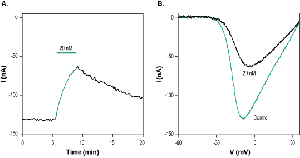 A potent blocker of the skeletal muscle voltage-gated sodium NaV1.4 channel that also inhibits other TTX-sensitive neuronal NaV channels
- Product Code: STC-400
- Short Description: A potent blocker of the skeletal muscle voltage-gated sodium NaV1.4 channel that also inhibits other TTX-sensitive neuronal NaV channels
- Applications: Electrophysiology
- MW: 2604 Da
-
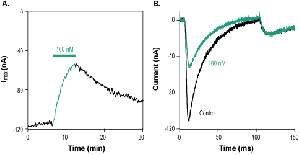 A potent and selective blocker of skeletal muscle NaV1.4 voltage-gated sodium channels
- Product Code: STC-280
- Short Description: A potent and selective blocker of skeletal muscle NaV1.4 voltage-gated sodium channels
- Applications: Electrophysiology
- CAS No.: 129129-65-3
- MW: 2609 Da
-
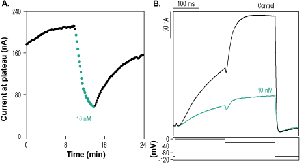 A potent and selective blocker of hERG (KV11.1) potassium channels
- Product Code: STB-470
- Short Description: A potent and selective blocker of hERG (KV11.1) potassium channels
- Applications: Electrophysiology
- CAS No.: 524962-01-4
- MW: 4092 Da
Loading...