

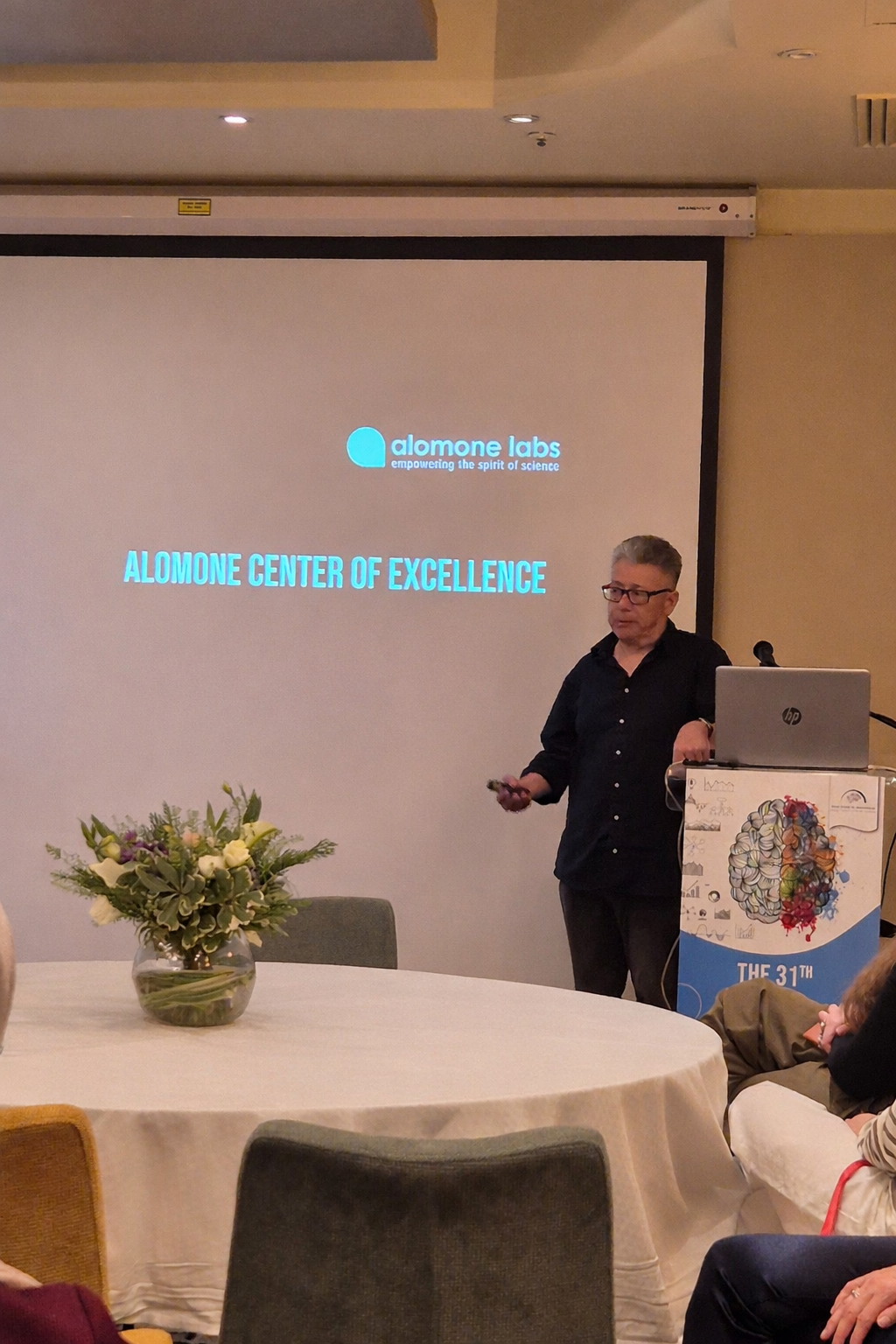
Alomone Labs Center of Excellence
What you can obtain by taking advantage of the Center of Excellence
Center of Excellence collaborations are selective by design. Therefore, we can stay closely involved at the scientific level because we want these collaborations to be hands-on partnerships built around your experimental needs.
As part of a collaboration, we provide:
- Selected reagents free of charge, including standard products or customized conjugates tailored to your project.
- Direct scientific involvement from our R&D scientists in antibody design, validation, and application optimization.
- Scientific support from early feasibility testing through data generation that is suitable for publication.
Reagents are only part of the collaboration. We also contribute scientifically to help optimize performance in your specific experimental context.
Publications and scientific credit
The work you produce is your own, to publish where you see fit – as it should be.
When a Center of Excellence project results in a peer-reviewed publication, we ask for co-authorship for our scientists who were directly involved in reagent development, customization, or scientific support for the work. This reflects a genuine scientific contribution and supports transparency in reagent-based research.
We will not claim ownership of your data or influence your publication timing, and we don’t need to review the manuscript before submission.
Interested in joining?
If your lab is developing or applying methods that demand well-validated, application-ready reagents – and you want a collaborator who will stay involved scientifically – we’d love to hear from you.
Leading Research Partnerships
Bryan R. Smith, Ph.D. Associate Professor Department of Biomedical Engineering Institute for Quantitative Health Science and Engineering Director of the Translational NanoImmunoEngineering Laboratory at Michigan State University
Dr. Bryan R. Smith is a nanomaterials bioengineer and Professor whose lab leverages an interdisciplinary blend of engineering, imaging, chemistry, biology, physics, and medicine to develop and exploit new imaging and therapeutic approaches. Dr. Smith is developing new nanotechnology-based strategies to harness the power of the immune system to diagnose and treat disease. creating novel diagnostic imaging and therapeutic technologies for living subjects. Major thrusts of the lab include “nano-immunoimaging” and “nano-immunotherapy”, which involve the use of nanoparticles to selectively target immune cells, visualize inflammation or disease processes in vivo, and deliver drugs with high precision while minimizing side effects. Other key projects in the lab range from in vivo imaging of cellular mechanical properties to drug release monitoring and biomaterials development. His Translational NanoImmunoEngineering (T-NIE) laboratory places particular emphasis on inflammatory conditions, primarily including cancer, atherosclerosis, and diabetes.
Gea-Ny Tseng, Professor of Cellular, Molecular, and Genetic Medicine at Virginia Commonwealth University.
Our lab focuses on uncovering the molecular mechanisms that regulate ion channel function in healthy and diseased cardiac myocytes, with particular emphasis on how ion channels are structured, expressed across different regions of the heart, and dynamically trafficked within adult cardiac cells. A central current interest is understanding the cellular control of ion channel trafficking and how these processes are altered in cardiac pathology or by genetic variants affecting ion channels or their associated anchoring and guiding proteins. To address these questions, the lab integrates patch-clamp electrophysiology to assess functional channels at the myocyte surface, biochemical approaches such as cellular fractionation and immunoblotting to quantify protein distribution, and high-resolution 3D fluorescence imaging of live or fixed myocytes to visualize ion channel localization and trafficking across subcellular compartments.
Aitor Aguirre, Associate Professor of Biomedical Engineering at Michigan State University
Research in the Aguirre laboratory is focused on stem cell and tissue engineering approaches to improving human cardiovascular health. They develop innovative technologies and models for engineering and repairing human hearts employing integrated approaches that include the use of pluripotent stem cells, heart organoids, in vivo cellular reprogramming and tissue engineering. The lab’s long-term goal is to create fetal and adult models of the human heart for research, therapy and technology development. These models will enable a new era of treatments for cardiovascular conditions in children and adults.