

How a Single Pathway Rewires Fear in Mice
Losing the fear response, or fear extinction, depends on synaptic weakening in the lateral amygdala. Mice that fail to extinguish fear show the opposite: enhanced synaptic potentiation and a skewed receptor profile. A new study shows that activating the NT3-TrkC pathway restores balance by upregulating GluN2B-containing NMDA receptors and suppressing long-term potentiation (LTP), which enables fear suppression (1).
Researchers categorized fear-conditioned mice as extinction (EXT)-success or EXT-failure based on freezing behavior across extinction sessions. Both groups learned fear equally well, but only EXT-success mice reduced freezing over time. In lateral amygdala slices, EXT-success mice showed strong long-term depression (LTD), attenuated LTP, and higher GluN2B expression; EXT-failure mice showed the opposite.
Immunostaining of synaptoneurosome preparations revealed higher levels of GluN2A in EXT-failure mice and higher GluN2B levels in EXT-success mice. These differences were quantified using a panel of cell surface-binding antibodies that only target an extracellular epitope found in each antigen: Anti-NMDAR2A (GluN2A) (extracellular) Antibody (#AGC-002), Anti-NMDAR2B (GluN2B) (extracellular) Antibody (#AGC-003), Anti-GluR1 (GluA1) (extracellular) Antibody (#AGC-004), and Anti-GluR2 (GluA2) (extracellular) Antibody (#AGC-005) (Figure 1).
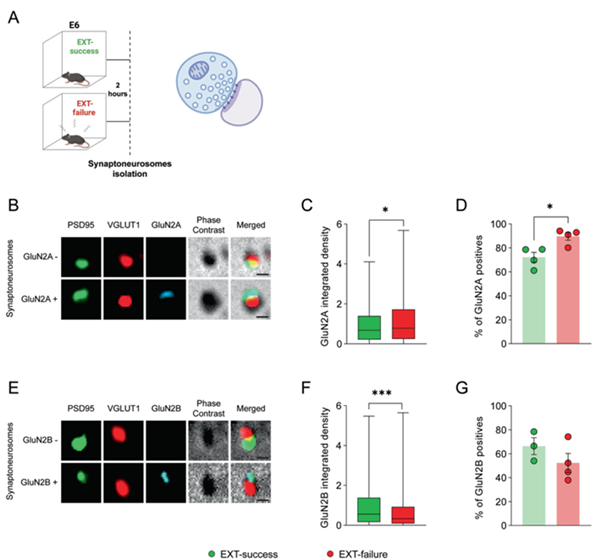
Figure 1. Distinct GluN2A and GluN2B Expression in Amygdala Synaptoneurosomes. A) Schematic representation of the experimental setup showing the collection of amygdala tissue from mice that either succeeded (EXT-success) or failed (EXT-failure) to extinguish fear in extinction trial 6 (E6), collected 2 h post-E6 during the extinction consolidation window. Synaptoneurosomes were isolated from the amygdala tissue for analysis. B, E) Representative images of synaptoneurosomes isolated from the amygdalae of EXT-success and EXT-failure mice, live stained for GluN2A (panel B) and GluN2B (panel E) subunits of NMDA receptors. Synaptoneurosomes were identified by co-staining against the postsynaptic marker PSD95 and the presynaptic marker VGlut1. Inspection of intact membranes were monitored by phase contrast. Scale bar: 0.5 µm. C, F) The integrated density of GluN2A and GluN2B signals were quantified in synaptoneurosomes isolated from the amygdalae of EXT-success and EXT-failure mice (GluN2A *p ≤ 0.05; GluN2B ***p ≤ 0.001). D, G) The percentage of GluN2A- and GluN2B-positive amygdala synaptoneurosomes was calculated for EXT-success and EXT-failure mice (n = 4 independent experiments), suggesting a shift in NMDA receptor composition. Statistics: Mann–Whitney U-test (C, F); two-tailed Student’s t-test (D, G). Adapted from Masella et al., 2024.
To test causality, NT3 was infused into the basolateral amygdala of EXT-failure mice. This intervention reduced LTP, boosted GluN2B levels, and rescued extinction. Conversely, blocking TrkC with a TrkC-Fc chimera in EXT-success slices enhanced LTP, mimicking the EXT-failure phenotype. In vitro, NT3 application to amygdala slices attenuated LTP in a GluN2B-dependent manner and co-application of the GluN2B antagonist ifenprodil blocked this effect.
Mechanistically, NT3-TrkC signaling reduced GluN2A levels and increased GluN2B expression at the synapse, tilting receptor composition toward an extinction-permissive state. GluA1 and GluA2 levels were unchanged, suggesting the effect is specific to NMDA receptor subunit remodeling.
To support your investigation of NT3-TrkC signaling and its impact on synaptic plasticity, we offer key reagents for the proteins explored in this study. Our Human TrkC-Fc Chimera (#RPC-004) enables selective blockade of endogenous NT3-TrkC signaling, mimicking the phenotype observed when the pathway is disrupted. Our recombinant Human NT-3 (#N-260) allows targeted activation of TrkC, facilitating in vitro and in vivo modeling of fear extinction mechanisms.
The authors conclude that “NT3-TrkC signaling attenuates LA LTP in a GluN2B-dependent manner”, which offers a mechanistic explanation of why some individuals extinguish fear more effectively than others. These findings point to NT3-TrkC as a potential therapeutic axis for anxiety disorders where exposure therapy falls short.


