-
 A Rabbit Polyclonal Antibody to KV1.5 (KCNA5) Channel
- Product Code: APC-004
- Short Description: A Rabbit Polyclonal Antibody to KV1.5 (KCNA5) Channel
- Host: Rabbit
- Label: Unconjugated
- Reactivity: Human, Rat, Mouse
- Applications: Western blot, Immunocytochemistry, Immunofluorescence, Immunoprecipitation, Immunohistochemistry
- Target: Potassium voltage-gated channel subfamily A member 5
-
 A Rabbit Polyclonal Antibody to KV1.5 (KCNA5) Channel Conjugated to the Fluorescent Dye ATTO-550
- Product Code: APC-004-AO
- Short Description: A Rabbit Polyclonal Antibody to KV1.5 (KCNA5) Channel Conjugated to the Fluorescent Dye ATTO-550
- Host: Rabbit
- Label: ATTO 550
- Reactivity: Human, Rat, Mouse
- Applications: Immunofluorescence, Immunohistochemistry
- Target: Potassium voltage-gated channel subfamily A member 5
-
 A Rabbit Polyclonal Antibody to KV2.1 Channel
- Product Code: APC-012
- Short Description: A Rabbit Polyclonal Antibody to KV2.1 Channel
- Host: Rabbit
- Label: Unconjugated
- Reactivity: Human, Rat, Mouse
- Applications: Western blot, Immunocytochemistry, Immunofluorescence, Immunohistochemistry
- Target: KCNB1, DRK1, Delayed rectifier potassium channel 1, Potassium voltage-gated channel subfamily B member 1
-
 A Rabbit Polyclonal Antibody to KV4.2 Channel
- Product Code: APC-023
- Short Description: A Rabbit Polyclonal Antibody to KV4.2 Channel
- Host: Rabbit
- Label: Unconjugated
- Reactivity: Human, Rat, Mouse
- Applications: Western blot, Immunocytochemistry, Immunofluorescence, Immunoprecipitation, Immunohistochemistry
- Target: Voltage-gated potassium channel subfamily D member 2, KCND2, Shal1, RK5
-
 A Rabbit Polyclonal Antibody to KV4.2 Channel Conjugated to the Fluorescent Dye ATTO-633
- Product Code: APC-023-FR
- Short Description: A Rabbit Polyclonal Antibody to KV4.2 Channel Conjugated to the Fluorescent Dye ATTO-633
- Host: Rabbit
- Label: ATTO 633
- Reactivity: Rat, Mouse
- Applications: Immunofluorescence, Immunohistochemistry
- Target: Voltage-gated potassium channel subfamily D member 2, KCND2, Shal1, RK5
-
 A Rabbit Polyclonal Antibody to KV4.3 Channel
- Product Code: APC-017
- Short Description: A Rabbit Polyclonal Antibody to KV4.3 Channel
- Host: Rabbit
- Label: Unconjugated
- Reactivity: Human, Rat, Mouse
- Applications: Western blot, Immunocytochemistry, Immunofluorescence, Immunoprecipitation, Immunohistochemistry
- Target: Voltage-gated K+ channel subfamily D member 3, KCND3
-
 A Rabbit Polyclonal antibody to L1CAM (extracellular)
- Product Code: ANR-047
- Short Description: A Rabbit Polyclonal antibody to L1CAM (extracellular)
- Host: Rabbit
- Label: Unconjugated
- Reactivity: Human, Rat, Mouse
- Applications: Indirect flow cytometry, Live cell imaging, Western blot, Immunohistochemistry
- Target: L1 Cell Adhesion Molecule, Neural Cell Adhesion Molecule L1, NCAM-L1, CAML1, CD171
-
 A Rabbit Polyclonal Antibody to LAT1
- Product Code: ANT-105
- Short Description: A Rabbit Polyclonal Antibody to LAT1
- Host: Rabbit
- Label: Unconjugated
- Reactivity: Rat, Mouse
- Applications: Western blot, Immunohistochemistry
- Target: CD98, Large neutral amino acids transporter small subunit 1, L-type amino acid transporter 1, 4F2 light chain, 4F2LC, Integral membrane protein E16, MPE16, Solute carrier family 7 member 5, TA1, Tumor-associated protein 1
-
 A Rabbit Polyclonal antibody to Leptin Receptor (extracellular)
- Product Code: ALR-039
- Short Description: A Rabbit Polyclonal antibody to Leptin Receptor (extracellular)
- Host: Rabbit
- Label: Unconjugated
- Reactivity: Rat, Mouse
- Applications: Indirect flow cytometry, Live cell imaging, Western blot, Immunohistochemistry
- Target: LEPR, OB receptor, OBR, CD295
-
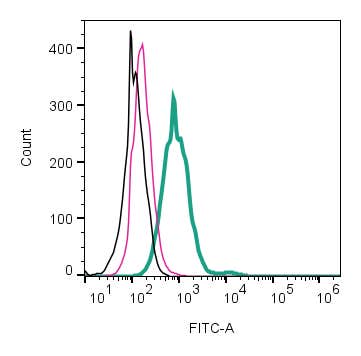 A Rabbit Polyclonal antibody to Leptin Receptor (extracellular) conjugated to the fluorescent dye FITC.
- Product Code: ALR-039-F
- Short Description: A Rabbit Polyclonal antibody to Leptin Receptor (extracellular) conjugated to the fluorescent dye FITC.
- Host: Rabbit
- Label: FITC
- Reactivity: Rat, Mouse
- Applications: Live cell imaging, Flow cytometry
- Target: LEPR, OB receptor, OBR, CD295
Loading...