Aging is widely assumed to erode hematopoietic stem cell (HSC) performance across the board. Older bone marrow typically contains more phenotypic HSCs, but most of them have already lost the ability to regenerate blood. A new Nature Aging study challenges this simple decline story by showing that a small population of aged HSCs remains metabolically active, functionally resilient, and surprisingly capable of long-term self-renewal (1).
And the distinction came from a single measurable feature: mitochondrial mass.
Mitochondria-enriched HSCs Aren’t Exhausted – They’re the Ones That Still Work
Researchers used a mitochondrial reporter (mito-Dendra2) to quantify mitochondrial content in HSCs isolated from aged mice. The expectation was straightforward: high mitochondrial mass would signal damage, accumulated stress, or impaired autophagy – hallmarks of aging. But when the team transplanted purified mito-Dendra2 High and mito-Dendra2 Low aged HSCs into mice, the results overturned that assumption.
Although both groups produced similar peripheral blood output, mito-Dendra2 High HSCs generated more donor-derived long-term HSCs in the bone marrow 16 weeks after transplantation. In other words, the very cells predicted to be the most exhausted turned out to be the ones still able to persist in the niche and maintain stem cell identity.
This raised the question, what distinguishes these mito-Dendra2 High cells at the molecular level?
Aging Reshapes the Stem Cell Pool… but not Uniformly
Single-cell transcriptomics provided the first clue. Among aged HSCs, the mito-Dendra2 High subset expressed elevated levels of genes involved in autophagy, mitophagy, iron metabolism, and various mitochondrial quality control pathways. These are the systems that buffer cells against metabolic collapse. Therefore, mito-Dendra2 High HSCs appear to survive aging not because they avoid stress, but because they maintain the machinery to process it.
The team also identified a transcriptionally distinct signature centered on Gpr183, a gene encoding an oxysterol receptor rarely associated with stem cell biology. Its expression correlated tightly with the mito-Dendra2 High state, suggesting it could serve as a surface marker for this resilient subpopulation.
Mechanistically, GPR183 responds to dihydroxylated oxysterols such as 7α,25-dihydroxycholesterol, which is a cholesterol metabolite that integrates lipid metabolism with redox‑sensitive pathways. If we examine the immune and vascular systems, we observe that oxysterol-GPR183 signaling primarily tunes cellular positioning, migratory behavior, and stress‑related gene programs. This results in context‑dependent effects on survival and senescence rather than acting as a classic mitogenic driver (2–4). Therefore, the appearance of GPR183 in aged HSCs immediately suggests a link between mitochondrial activity, lipid handling, and stem cell persistence.
Oxysterols rise with age. At the same time, mitochondrial turnover, oxidative stress, and lipid peroxidation promote the accumulation of cholesterol oxidation products that engage GPR183 and other sensors in tissues undergoing vascular and inflammatory aging (5–7). Therefore, cells that maintain controlled mitochondrial output and sterol processing are uniquely positioned to use GPR183 signaling as a stabilizing input rather than a stress signal.
Flow Cytometry Turns a Transcriptomic Hint into a Functional Experiment
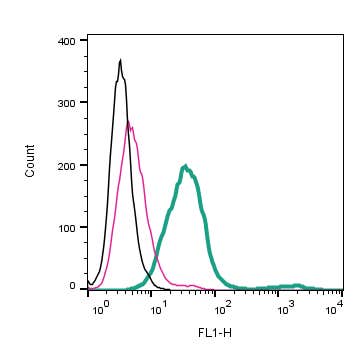
With Gpr183 emerging from single-cell data, the next question was whether the GPR183 protein actually mark these functionally persistent HSCs. Flow cytometry provided the answer. Staining with Anti-GPR183 (extracellular)-FITC Antibody (#AGR-063-F) and it’s matched Rabbit IgG Isotype Control (#RIC-001-F) revealed that GPR183high cells were almost exclusively found in aged signaling lymphocyte activation molecule family (SLAM)-HSCs, and their abundance closely tracked with mitochondrial mass. Young HSCs exhibited little to no GPR183 signal – another sign that this receptor is tied to the altered metabolic landscape of aging. This allowed for the sorting of GPR183high and GPR183neg aged HSCs for direct functional testing and that separation proved decisive.
In bone marrow transplantation assays, GPR183high HSCs produced more donor-derived long-term HSCs in the recipient marrow, while GPR183neg cells skewed toward differentiation, particularly myeloid output. In ex vivo expansion experiments, GPR183high cells, maintained stem-enriched fractions more effectively, whereas GPR183neg cells expanded but lost stem identity. Colony-forming assays showed a similar divergence, where GPR183neg cells formed more differentiated colonies, consistent with reduced self-renewal capacity.
Together, flow cytometric separation by GPR183 expression revealed a functional bifurcation inside the aged HSC pool – one that mitochondrial content alone hinted at but could not fully explain.
What Mitochondrial Mass Actually Means in an Aging Stem Cell
A major takeaway of the study is conceptual: mitochondrial accumulation in aged HSCs does not automatically denote dysfunction. In young cells, high mitochondrial mass usually signals differentiation or stress. But in aged bone marrow, the rules appear different. The mito-Dendra2 High, GPR183-marked HSCs maintain a higher mitochondrial DNA content, active mitophagy, and managed to hold on to their metabolic flexibility.
Rather than being clogged with damaged organelles, these cells seem to maintain – or reactivate – the mitochondrial maintenance pathways required for long-term survival. This reframes an old assumption in stem cell aging, suggesting the problem may not be that all HSCs lose capacity, but that only a minority retain the machinery to cope with an aging niche.
Implications for Aging Research and Regenerative Hematology
The discovery of a metabolically resilient, mitochondria-enriched HSC subset suggests several consequences for the field. First, that aging is selective, not globally degradative. We observe that some HSCs maintain their identity because they preserve mitochondrial and autophagic control systems. Secondly, it’s clear that surface markers for resilience now exist and GPR183 provides a practical handle for isolating functional aged HSCs – something previously impossible at the protein level.
There’s also the notion that functional decline in aging may reflect population shifts rather than a universal decay. This means therapeutic strategies could aim to expand, preserve, or preferentially transplant this resilient subset. Finally, mitochondrial phenotyping deserves renewed attention since mitochondrial mass and turnover map directly onto stem cell outcomes in aging marrow.
This work underscores that aging biology is rarely linear. What looks like deterioration can mask hidden pockets of durability – cells that maintain essential processes long after their neighbors falter. Identifying these cells required careful metabolic profiling, transcriptomic analysis, and flow cytometry-based sorting. But the payoff is significant: a new definition of what it means for a stem cell to age.